Showing posts with label history. Show all posts

03 November 2011

Dresden 2011

0 comments
Our friend, Mark, visited for a week in October. Mark had visited Koblenz in the past and so wanted to see some other part of Germany while he was here. The facts that had seen some pictures of Dresden while watching the Women's World Cup games that took place in the "Florence on the Elbe" and that Dresden is the sister city of Columbus, Ohio, our hometown, made Dresden a logical choice for a visit.

Dresden is almost exactly a 5 hour drive from Koblenz. With Mark arriving on a Monday, returning the following Sunday, spending a day at BUGA, and another day on a hike around Koblenz, that left 3 days to drive to Dresden and see the city.

On a rainy Wednesday mourning, we got into the car and started off to Dresden. Driving east from Koblenz in not the easiest thing. The autobahn system is much more geared to North-South traffic. There is a good autobahn traveling southeast to Limburg. East from there are a combination of  an two lane highways and limited access highways (autobahn "want-a-be"s) that seem to be under continual construction but that does take the traveler through the farmlands of Hessen and the "dead zone" around the former border to the DDR. Then a few kilometers before the former border, the highway becomes a wonderful new autobahn. So new that for a large part of the remainder of our journey, our two year old GPS showed us racing across the green fields of Thuringen at 130 km/hr while it kept trying to correct our route to some abandoned road to the south.'

Dresden's Frauenkirche
We arrived in Dresden in the early afternoon and found our hotel, a newly opened ETAP conveniently located near at the Altmarkt. ETAP is one of the budget chains that is a part of the Accor hotel group. They have opened a number of new ETAP hotels in  major cities across Europe. While these new ETAPs have the ambiance of a youth hostel, they are inexpensive, clean and located near the tourist attractions. Obviously if  you feel that a part of traveling is enjoying drinks at the hotel bar or relaxing in a plush hotel room, ETAP is not for you. The Dresden ETAP had been opened just two months, was clean, had helpful staff, was in walking distance of the major attractions and was quite cheap. While it suited us just fine, I have to agree with the review I read that suggested that the room designs are such that you would only consider sharing a room with people that you are very close to.

After checking in, we took off, map in hand, to get our bearings and to visit at least one museum. The majority of the Baroque reconstructions in Dresden are centrally located in the Altstadt along the Elbe. The reconstruction of the buildings destroyed during the Feburary 1945 bombings started during the DDR time and continues today. Reconstruction of the 18th century Frauenkirche, a symbol of Dresden, took 13 years and was completed in 2005, one year before the 800th anniversary of the city founding.

A large part of Dresden's Altstadt (Old City) is pedestrian only, so it is great for strolling. As I mentioned, the areas is fairly compact, but big enough to have a lot of interesting buildings packed into them. Included in this area are the Frauenkirche, the Opera, the Hofkirche, the Fürstenzug, the palaces containing the major museums, and the river front.  The fact that there is a similarity in the architecture style and construction materials, seems to make it seem like there is more. There are open areas with interesting sight lines, and small streets. There are unexpected and elaborate fountains. The river front is dramatic. There is a thriving restaurant and bistro scene with tables spilling on to the streets and filled with people, even on a cold day. Or if warmth is desired, you can sit behind the large glass windows enjoying your favorite drink and a bit of people watching. The only negative thing about the restaurants in Altstadt is that a number of them seem to be parts of larger restaurant groups as a lot of the names are recognizable if you spent any time in Munich or Berlin.

Most of the Baroque buildings in Altstadt have been built with the same stone. That may not be obvious at first as a number of the buildings are black, while the the newer ones are a light brown. Our first thought is that some of these builds just need a good cleaning, but that is not the case. Rather the stone contains iron that oxidizes when exposed to the air. Over time, all the building will take on this blackness.

After strolling around the Altstadt, it is possible to continue across the Augustus Bridge to Neustadt (New City). The "new" here is relative. This part of Dresden dates back to 1732. There is still a neighborhood of Baroque builds that survived the bombings, although it is necessary to pass though a block of post WWII soviet style buildings to get there. There are a number of small antique shops (most selling Meissen) and other small shops that are interesting to visit. Also a number of restaurants that seem locally owned and are a bit less expensive than in Altstadt.

For centuries, Dresden has been a cultural and artistic center. Through its Brücke artists, Dresden was a very important city in the development of expressionism. For this reason, our first museum we headed for was the Galerie Neue Meister (the Galley of New Masters). Unfortunately, the expressionist collection was not as large as we had hoped. In retrospect this may have been more a problem with our expectation. Expressionism was after all considered "decadent art" during the Hitler years, and likely had little following in the post-WWII authoritarian government. There was a handful of paintings from the Brücke artists, and a number of seldom seen impressionist and post-impressionist to make the trip worthwhile.

Probably the most interesting collection at the Galerie Neue Meister was a special exhibition called the Neue Sachlichkeit (the New Objectivity). During the 1920s, Dresden, Hanover and Karlsruhe became centers for this new artistic style that attempted to depict the emotional reality of the post-WWI life around them. The pictures were of unemployed people, war invalids, as well as working women and children. Some were hard  to look at, others beautiful in their elegant depictions. All showed the wide-spread depression of life in Germany at this time, the Germany that gave birth to Hitler.

The surprising highlight of the visit was the Gemäldegalerie Alte Meister (Old Masters Picture Gallery). In honor of the 500th anniversary of Dresden's most famous painting, Raphael's Sistine Modonna. Well you might not be familiar with the painting, I'm guessing that most people have seen a part of it. That is the two angels at the bottom might be the most famous two angels ever painted. In honor the this anniversary and the pope's visit to Germany this year, the museum had a special exhibition of Madonnas from a number of famous painters. Included here was another Madonna that Raphael painted at the same time. Since this second Madonna is owned by and has never left the Vatican, this was the first time the two painting have appeared together since they were in Raphael's workshop 500 years ago. 

The Gallery also a wonderful collection of Dutch School paintings that include a number of impressive Rembrandts and delightful Vermeer (Girl reading a Letter at an Open Window). 

09 October 2011

Visiting Friends in Normandy

0 comments
As the son of a history teacher who grew up in the shadow of WWII, when we decided to accept the invitation from a couple of friends to visit them in Normandy, there was little choice about one part of our literary. We did visit Omaha Beach and the American Cemetery near by. It was an emotional experience, but only one of many highlights from our trip.

Two of our neighbors in Columbus were working in France. Jim is a medievalist and Ann is an expert in Gothic art, both former professors of art at the Ohio State University. Jim has spend part of the last 20 years studying the Abbey at Jumièges. So when we got an invitation to visit them and perhaps see a bit of Gothic France through the eyes of these experts, we jumped at the chance.

Tympanum of the central west portal
Amiens Catheral
On the way to Jumièges, we stopped in Amiens to see the Notre Dame Cathedral there. This cathedral, started in the 13th century, has the highest ceiling  of all completed cathedrals in France, and also largest interior volume. The exterior of the cathedral is famous for the quality of the sculpture on the north and west entries, and for the tall central spire. The interior is surprisingly light, with large nave and chancel. The ambulatory around the choir provides access to a number of richly decorated chapels. The floor of the nave features a large labyrinth (walking the labyrinth was equivalent to a pilgrimage to Jerusalem) and swastikas that in the 13th century symbolized the triumph over death by Jesus.

Jumièges is a small town on the Seine. It one major tourist attraction is the ruins of the Benedictine Monastery that was founded in 654 AD. The monastery operated up until the French Revolution (which was as much a revolution against the church as against the monarchy). At the time of the Revolution, it was one of the largest monastery complexes in France, containing two churches, cloister, library, walls, and a number of other buildings made from the white limestone quarried in the area. But after the revolution, it was closed and sold off. The owner used the complex as a quarry, tearing down the buildings and selling off the stones. What is left is impressive and beautiful, but gives only a hint at the former glory, as the slide show below indicates.


On the second day, we made it to Omaha Beach, but not before stopping off in Bayeaux to see the famous tapestry from the 1070s that illustrates the story of William's conquest of England. It is wonderfully displayed    behind glass, but at eye level. The audio guide that is provided as a part of the admission fee explains the illustrations as you walk along the 70 meter tapestry. Afterwards a short film tells a little more about the history of the tapestry.

Cliffs above Omaha Beach
Outwardly, Omaha Beach now appears for the most part to be just another a beach. But there are a few hint to the events of June 6. Most visibly are the two memorials on the beach dedicated to these events. Then is the museum that you pass just before arriving at the beach. And, of couse, there is the constant flow of tour buses, even on a an October day, bringing Americans, mostly my age or older it appears, on their pilgrimage to this hollowed ground in American history. Seeing the cliffs above the beach, you have to wonder how the US troops were able to over come such a disadvantage (and why such a spot would chosen to send these troops). The American Military Cemetery not far away is a reminder of the exactly what it did cost. It is a beautifully manicured cemetery overlooking the ocean and is deeply respectful of the sacrifice of these troops and a reminder for anyone that visits. I wanted to weep. It was only a couple of hours, but it was emotional.

The third day was spent in Rouen. Maybe it was that I didn't really have high expectations, but I as blown away by this city. It has a incredible wealth of 5-6 story, half-timbered medieval buildings. It just seemed like street after street, on both sides, we were fascinated by one building after another. Then there is the cathedral. You know the one that Monet painted in various lighting. The interior isn't much, but the exterior is pretty special. We were particularly intrigued by the reliefs and sculptures of the north portal. The following slide show contains pictures of some of these carvings that we found interesting.


19 August 2011

Discoveries on the Way to Meck-Pomm: Lübeck

0 comments
The first time that I saw Lübeck was returning from a trip to Copenhagen in 1991 (the year that I worked in Germany). I remember seeing the Holstentor (the main gate to Lübeck) from the train. It was impressive, but not impressive enough to make me go back to visit. Boy was I wrong. Walking through the streets of Lübeck is a delight. Perhaps my favorite city in Germany. Certainly on any short list of favorites.

The Lúbeck Altstadt (old town) sits on an island in Trave. It was the capital of the Hanseatic League, the cartel of German and Dutch cities that controlled north-south trade routes in the 13th to 17th centuries. It has maintained much of the medieval character as befitting an important harbor town during this period. The preferred building material was brick, red or glazed black (stone quarries don't exist in the low lands near the ocean), giving the city a feel of architectural unity.

The Hostentor on the west side of the city, was build between 1469 and 1479. It was the second gate of the main entry through the city's perimeter walls (it actually predate the building of the walls). Now it stands in the middle of a small park at the end of the main bridge into the city. Like many of the medieval brick buildings in Lübeck, the Hostentor has quite a lean to it today. Still it is among the most famous buildings in Germany, and so use to be on the 50 deutschmark bill.

The Rathaus (city hall) dating from 1250 sits between the Markplatz and Breite Straße, the main pedestrian shoping street in Lübeck. On Breite Straße across from the Rathaus is Cafe Niederegger, a Mecca for lovers of marzipan (like me).

Marienkirche is the largest, and oldest brick Gothic churches in Germany. It was started in 1250 and was used as a model for 40 some brick Gothic churches in North Germany. The church was bombed in 1942, starting a fire that burned the supports for the bells. This caused the bells to soften by the heat of the fire and to fall from the bell tower.The partially melted bells remain today where they fell in 1942 at the base of the south tower, a reminder to the horror of war.

Next to the church is the Buddenbrookhaus. This house was owned by the grandfather of Heinrich and Thomas Mann. The brothers were frequent guests in the house in their youth. Thomas Mann used the house in his famous book Buddedbrooks about the rise and fall of a patrician family in Lübeck.

Henry the Lion laid the corner stone of the Romanesque Cathedral in 1173. The cathedral was finished in 1230. Henry the Lion was the Duke of Saxony from 1140 to 1180 and Duke of Bavaria from 1156 to 1180. In addition to founding Lübeck, he is credited with the founding of Munich, Lüneburg and Braunschweig. The 'Paraise', the Gothic entrance way to the north trancept was added in 1260. In the interior of the church is a large Gothic Crucifix made between 1470 and 1477. The south tower has a noticeably southern lean to it. Two large steel beams connecting the north and south towers have been added to prevent further leaning. I haven't found anything that explains to the reason for this lean. My speculation would be that it is connected with the bombing of 1942 that damaged east and north sections of the church. Reconstruction was delayed several years because priority was given to Marienkirche. It was finished in 1982.

Two other churches worth noting are the Katharinenkirche and Petrikirche. The 14th centruy facade of Katharinenkirche contain rows of niches that hold statues. The first three left of the lowest row of niches hold statues made by Ernst Barlach, a late 19th to early 20th century expressionist sculptor, printmaker and writer. Petrikirche has an elevator that takes the visitor to an observation tower in the top of the tower, offering fantastic views of the city.

But this list of sights does not do justice to the feeling one gets just meandering the small winding streets of this ancient city with their brick row houses. Or setting at a table in an outdoor cafe along the Trave, watching the boaters while the city towers are reflected off the still waters of the river. It is a truly beautiful city.

Frannie's favorite thing was the park that had been created where one of the city wall use to stand. The city invites people to let their dogs run off leash in this park, a rarity in Germany.

Interestingly, shortly after we returned from our vacation, the New York Times Travel Section had an article about Lübeck. Click here to take a look at their advice.

06 February 2011

Hochwasser and The Lady Gets Another One

0 comments
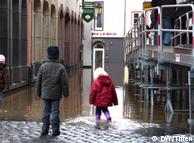
During the middle of January, we where experiencing flooding along the Rhine and Moselle. Neuendorf and Wallersheim (where we live) was particularly hard hit as they are the villages just below the confluence of these two rivers. The waters reached the 7.5 meter mark, well below the record flood levels of around 9.5 meters. but still enough to cover the first story of most of the homes along the Rhine. Our building is high enough that were relatively unaffected. However, Franny did have to experience a change in her routine walks.

For many affected, this was nothing new. The fire department came in before the flood waters reached the town and build walkways allowing people to access the second floor of their homes. People along the river have learned to live mostly on the second floor anyway. Rooms on the first floor only contain furniture that can easily be moved to the second in case of floods. Cars were moved to parking areas on higher ground. And many people stayed in their homes.


Probably the most disruptive event occurred on the Rhine, a few miles upriver, at the base of the Lorelei cliffs. This is a place where the Rhine river narrows and turns as passes around the cliffs. As long as the Rhine has been used by boats, the swift water and turn on this particular section has been a problem for boat captains. The accidents gave rise to the legend of Lorelei, the naked siren with cooper hair that would sign such a beautiful song that she would boat captains into a accident in the swift waters.
 

On January 18, Lorelei got another. This time it was a tanker, the TMS Waldhof,  carrying 2000 tons of sulfuric acid. The big problem here is that the combination of sulfuric acid and water can be explosive, and a couple of the tanks developed leaks that was allowing water into them. It took awhile to get the necessary equipment into place to stabilize the situation. During this time, boat traffic was not permitted along the river at this point, and detours were set up for auto route along the river.. Many boats have had to dock and wait until it was safe. That occurred on Friday morning around 9:30 am. The Waldhof is still in the water, but the tanks have been drained and it is now safe to continue the rescue.


25 November 2010

Germany's November Bird

0 comments
Although it is a relative recent addition to the German menu, Germans do like turkey. It is however not often roasted as a whole bird. Happily, we are able to buy whole turkeys in the groceries this time of year. Also everything that is needed for the trimmings, including the dreaded cranberry. But I think this is because there are enough Americans (and curious Germans) living here to create a market at this time of year.

For Germans when it comes to roasted poultry in November, the bird of choice is goose. From the end of October you see frozen goose being offered in the grocery stores. Butcher shops ofter the ability to order a fresh goose. Restaurants have been advertising goose dinners. This reaches a climax each year on November 11th, put does continue through the end of the month.

One reason for this tradition dates back to the 4th century B.C. St. Martin day is November 11th. Legend has it, that upon hearing that he was to become the Bishop of Tours, St. Martin hid in a goose barn because he felt himself unworthy of the honor. However the honking of the geese gave St. Martin away. So the goose has been associated with St. Martin. There is an alternate legend to explain the association of the goose to St. Martin. According to this legend, a goose made so much noise during a service that St. Martin held that it annoyed the saint. As a result, that goose ended up on the table that evening.

In the 6th century, several things came together to secure the goose a place on the table for November 11. First it had become the beginning of 7 weeks of fasting between St.Martins day and Christmas. So a good meal was important. Second and perhaps related, November 11th had become the end of both the financial and farming year. So at this time of year, livestock that would not make it through the year was slaughtered and preserved. Geese would never be so plump as at this time of year. Peasants had to pay 10% of their production to the landlord. What they ate beforehand would not be counted. Still the landlords were receiving an abundance of geese that would not survive the winter. But as it was the end of the financial year as well, the laborers and handmaidens were dismissed on this day and new ones hired for the next year. Landlords would give the dismissed employees a goose as a gift. All this conspired to make a lot of geese available for the November 11th table.

We did have goose one evening at a restaurant in Badenweiler. The traditional trimmings served in Germany with the goose are rotkohl (red cabbage). klöse (potato dumplings), apple sauce and roasted chestnuts. The spätburgunder (pinot noir) was a nice accompaniment.

16 May 2010

House of the History of the German Republic

1 comments
We took a quick trip up to the Museum Mile in Bonn to visit the Haus der Geschichte der Bundesrepublik Deutschland. This is a museum devoted to the history of the Germany since the forming of republic following WWII.

The museum is organized so that you feel you are walking through a time line starting in 1945 to the present. The initial displays then are about the liberation and occupation. There you can see photos and videos of the state of the German cities following the war, artifacts from the occupation, and exhibits about the Berlin airlifts. This period also includes coming to grips with the atrocities of the war.

The exhibits then flow into formation of republic, the political parties, and the division of Germany. From this point as you walk along the time line, there are displays showing the results of each German election to orient you along the time lines. Along the time line are presented displays illustrating the life in Germany and the forces effecting that life. These include things like the cultural influences, the political forces in play, the products being produced, immigration, and, of course, reunification.

Many exhibits are interactive, allowing you to experience the sights and sounds of the time. There is, of course, the video of John F. Kennedy in Berlin. Also a 1950 VW Beatle with its split rear window, a BMW Zeta, Zeiss Optics, interviews with immigrants and rock music.

It really is a nice museum, and it is free. You can buy a guide to the exhibition to 3€ that can help follow the displays. But even without that, there is much that someone without good knowledge of the German language can enjoy here.

07 March 2010

Bridge at Remagen

0 comments
As I was walking Frannie along (and in) the Rhine earlier this week on one of the days when the river was out of its banks. I started to think about the importance of the Rhine as a last line of defense for the Germans in WWII. That sparked a memory that the crossing of the Rhine happened about this time of the year. Sure enough, it occurred on March 7, 1945, 65 years ago today.

I suppose that this is an event that had more importance to Americans that lived during WWII or in its shadow. The Rhine seemed at the time a major obstacle to the advance on Berlin. The Germans had blown up all other bridges across the Rhine and had indicated that they would defend the Rhine with all that they had. So it was quite a surprise when elements of the 1st Army under Omar Bradley discovered the bridge intact. As the US forces approached, the Germans attempted to destroy the bridge, but the charges that had been set were not enough. The US forces captured the bridge and a way over the Rhine.

The bridge only stood for an additional 10 days. The attempt to destroy the bridge had damaged it, and it fell into the river on March 17th. By that time, 1st Army had moved significant men and materials to the other side of the Rhine and had managed to build a pontoon bridge for continued movement of troops and supplies.

A few days later on March 22/23, Montgomery's British forces to the north and Patton's 3rd Army to the south also managed to cross the Rhine in boats and began to build pontoon bridges to support their advances. Since the 1st Army slowed it's advance until Montgomery's and Patton's forces were able to cross, most historians today downplay the capture of the bridge. But the story I heard as a kid was quite different. Eisenhower said the bridge was "worth its weight in Gold". Plus it made a great movie.

By the way, I have visited to Remagen. It is about 40 miles north of Coblenz. It is a suburb of Bonn that has been hit very hard by the movement of the German capital from Bonn to Berlin. The bridge towers still stand on each side of the river, as well as the approach. The bridge was never rebuilt. The is a small museum in the tower on the west side of the Rhine. And plaques describing the capture and use of the bridge.