Showing posts with label Coblenz. Show all posts

05 January 2012

The Next Level in Parking Garages

1 comments
If you have driven in a German city of any size looking for a parking spot, you might have noticed signs like the one pictured here. The signs not only give directions to nearby parking garages, but also tell you how many places are available at each garage. The idea is to help save time, gas, traffic congestion and pollution by leading drivers directly to a garage with empty parking spaces.
Signs like these are possible because all the parking garages uses a similar system to control entry and exit from the garage. The driver pulls a ticket from an automat, thus initiating the lifting of the gate allowing the driver to enter the garage and then lowers the gate At the same time the automat is able to reduce the number of available parking spaces and transmit that to a computer to update the signs all over town. On returning to the garage to pick-up your car, the ticket is paid by inserting the ticket in an automat typically near the garage entrance. The automat figures the cost and displays it to the driver. Once the driver has paid, the automat marks the ticket as paid and returns the ticket to the driver. The driver then has about 15 minutes to find his/her car and leave the garage. At the garage exit, the ticket is inserted into a third automat. This automat lifts the gate allowing the driver to exit, increases the number of available parking spots, transmitting the change to a computer to update the signs and lowers the gate after the car has exited.

A new parking garage has opened in Koblenz that takes this idea to a new level. At the end of each row, there are two signs. One tell the number of parking spaces available in the row. The second tell the number of avail parking spaces if you continue further in the garage. Now in a nearly full parking garage, this is a pretty neat thing. No more driving down row after row looking for one of the last open spaces, hoping that someone else does find them first. But how is this done? I mean there are no gates on the individual parking spaces.
Well no, but there are sensors over each parking space. Here you can see that the sensor glowing red has detected our car in the parking space it monitors. Meanwhile, the sensor over the empty parking space next to us glows green.

10 September 2011

Be Careful when Digging

0 comments
Being careful when digging has a whole new meaning for construction projects here. Sure there are the underground wire and gas lines that require marking before you start digging (although a TV ad campaign reminding people on an almost daily basis to make the call doesn't seem to be needed. here). But there are other unexpected things that can be found that could really screw up the plans for a construction project.

250 lb bomb in Koblenz
One of those things is a bomb. Four times in about a 5 week period from late July to end of August, unexploded bombs dropped during WWII airstrikes have been found at sites in and around Koblenz.

The first of these was found on July 20, a Wednesday, while building an apartment house just south of the town center. This was a 250 pound British bomb. The location of this bomb was a bit inconvenient for a city that was trying to get to its 2,000,000th visitor to BUGA (the German National Garden Show). As it was  along the route of the BUGA shuttle, doing something about the bomb meant affecting visitors access to the show. Initially the city wanted to cover the bomb with steel palate and sand bags, then wait until a move convent time. But after a couple of days, plans for an evacuation of 3500 residents and 500 hotel guests were announced for Monday, July 25  was called for the area around the bomb and the bomb was removed.

The second was on August 10 occurred in Vallendar, the village just across the Rhine river from us when an American bomb was found. Then on August 23, at a construction site near the IKEA that is about 2 km from our appartment, a 500 lb British bomb was found. This one seem a bit more dangerous for a couple of reasons:

  • one because it was in the middle of one of Koblenz' biggest shopping areas and next to the the major road entering the town from the north,
  • and two because the fuse was a chemical fuse, which from the reports seemed harder to deal with. 
A one kilometer evacuation was started immediately and the bomb removed that evening. Since we live 2 km away and outside of the evacuation zone, we had no hint of what was happening and only learned about the bomb the next day.

1 Ton bomb in Osterspai
The forth bomb was found August 29th in Osterspai, just south of Koblenz. This was a one ton American bomb that was found in a field of fruit trees. There had been rumors of an unexploded  bomb in this field for years, but tests had never found anything before. That was until the 29th. The next day a 1 km evacuation that halted train and Rhine ship transports was called for and the bomb removed.


10 May 2011

BUGA is here

1 comments
BUGA (short for the Bundesgartenschau) is the German garden show that occurs every 2 years in different German cities. This year's show is taking place in Koblenz. The city has been preparing for this for well over a year, closing roads and bridges, changing parking regulations, refurbishing buildings and pedestrian walkways. So for residents of Koblenz, the opening BUGA a couple of weeks ago brought a sense of relief, if for no other reason than the removal of the orange barrels.

It is a big show distributed in three locations in the city. One part is near Deutches Eck, a second part around the Bishop's Place, and the third and largest part around the Fortress Ehrenbreitstein. The first two parts are connected by a walkway along the Rhine, but as Ehrenbreitstein lies high on the hill across the Rhine, connecting visitors to this third part required an interesting solution, a hanging cable car system was installed.

We made our first appearance last week and were quite pleasantly surprised. Since we have a season pass, we didn't feel the need to visit all of the show in the first day. So we concentrated on Deutches Eck and Ehrenbreitstein this time. Here are some pictures and impressions:
  • The gardens along the sides and back of St. Kastor were a highlight. Both were tulip gardens at the time. One was a explosion of colors with the 1200 year old Romanesque church as a backdrop. The other was much more contemplative with all white tulips.
  • Behind the church was a story board that summarized the 5000 years of human inhabitation in Koblenz. This also reveal a new discovery that had been made in preparation for BUGA. There has long been documentation of a Roman temple that was built about 2000 years ago near the confluence of the Rhine and Moselle, but the exact location was never known. In preparing the gardens, it was found. The choir of the church was built directly over the temple.
  • The cable car is a nice solution to connect the city with the fortress. The ride provides some unique views of Deutsches Eck and the city. Since this is was built within the areas that UNESCO designated as a world heritage site, the agreement is that the cable cars will be taken down at the end of the show. However, some are questioning if they should stay. On the positive side, providing such an easy connection between the city and the fortress (with its 3000 year history) would be a positive for tourism. On the negative side, UNESCO could withdraw their designation if the system stays.
  • Ehrenbreitstien has been restored wonderfully, and the view of the city from the courtyard is as good as ever.
  • The new observation platform on the northern end of the BUGA site around Ehrenbreitstein gives a different view of the city, but also an unexpectedly interesting view of the Rhine valley to the north.
  • One area of the show, and a pretty popular one at that, was devoted to graves. This might be surprising, unless you understand that maintaining the grave sites of loved ones has long been an important part of the German culture, although it is a part of the culture under some stress right now as people become more mobile.
  • Two large temporary building housed the various show plants. How judges decide a difference between gold, silver and bronze is hard (impossible) for me to see. Even the bronze orchids look good to me. Do you think a fly would feel better about being caught by a gold winning pitcher plant, than a silver of bronze one?

10 March 2011

Karneval in Koblenz

0 comments
The days prior to Ash Wednesday and Lent have different names in various parts of Germany. In and around Koblenz, they are called Karneval. Although the Karneval season officially begins each each at 11:11 on 11/11. This is when Karneval prince and princess are anounced and the Karneval clubs begin their planning for Karneval celebrations, including figuring out their theme for the coming celebrations, preparing their costumes and float, and planning their parties.

The actual Karneval celebrations begin the Thursday before Lent with "Schwerdonnerstag" (Hard Thursday). Many businesses close at noon, schools arrange in-service days so that the students don't have to be in school. Things begin with a symbolic storming of the city hall by the Karneval clubs. With the club members in costume, firing confetti cannons, the Karneval Prince demands the key to the city from the mayor. Women take the lead the rest of the day. Some women will go around carrying scissors, cutting off any ties worn by men on this day. At the parties later, women choose their dance partners.In fact, some folks refer to this day as Weibekarneval (Wife's Karveval).

Parties continue on Friday and Saturday. The foods most associated with this time of year are Berliners and Naunzen. Berliners would be recognized by Americans as a jelly doughnut, round pieces of yeast dough that are deep-fried, filled with jelly and sprinkled with sugar. Naunzen use the same dough as Berliners and like Berliners are fried and sprinkled with sugar, but unlike Berliners, are irregularly shaped and are not filled. By the way, Berliners are root of the Urban Legend that JFK called himself a "doughnut" when he said "Ich bin ein Berliner" before the Berlin Wall in 1963. In truth and in that context, there was no confusion for Germans. A Berliner is also a resident of Berlin and use of the adjective "ein" placed an emphases on his oneness with the people of Berlin. Exactly what he was trying to say. It remains a moment remembered in German history books and has a display devoted to it at Bonn's "House of German History".

On Sunday, parades get added to the entertainment. In our village of Wallersheim, there is a kids parade. Although I'm not sure what makes it a kids parade, other than the selection of the parades prince and princess, who were young kids. There are more adults than kids in both the parade and audience. A good percentage of the audience, young and old, are in a costume. And certainly, beer and wine are flowing in both groups. As the parade passes, everyone waves a hand over their head and shouts the greeting for Koblenz, "Oula" (in other parts of Germany the greeting would be "Hela").

Whereas in other parts of Germany, the celebrations are still rooted in the idea of scaring away the evil spirits of winter (see last years post on Fastnacht in southern Germany). The Karneval parades in this part of the country tend to be about political satire or current topics. Sort of reminds me of the Do Da parades on the 4th of Jully in the USA. This is one reason that even today many of the clubs still dress in costumes inspired by French or Prussian military from the 1700s. Karneval was used  as an opportunity to make some fun of their occupiers back then. This year, the current topic in Koblenz is the the upcoming national garden show, BUGA. So it is no surprise that to see a lot of costumes and floats with flower themes in this year's parade.

Smaller towns and villages have parades on either Sunday or Tuesday. Rosenmontag, the Monday before Ash Wednesday, is the parade day for the larger towns. Cologne's and Mainz's parades are shown on TV. In Koblenz, the parade attracted 100,000 watchers this year. Prior to the parade, the downtown was closed off to traffic and special buses carried people to and from the parade.

06 February 2011

Hochwasser and The Lady Gets Another One

0 comments
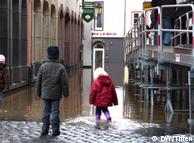
During the middle of January, we where experiencing flooding along the Rhine and Moselle. Neuendorf and Wallersheim (where we live) was particularly hard hit as they are the villages just below the confluence of these two rivers. The waters reached the 7.5 meter mark, well below the record flood levels of around 9.5 meters. but still enough to cover the first story of most of the homes along the Rhine. Our building is high enough that were relatively unaffected. However, Franny did have to experience a change in her routine walks.

For many affected, this was nothing new. The fire department came in before the flood waters reached the town and build walkways allowing people to access the second floor of their homes. People along the river have learned to live mostly on the second floor anyway. Rooms on the first floor only contain furniture that can easily be moved to the second in case of floods. Cars were moved to parking areas on higher ground. And many people stayed in their homes.


Probably the most disruptive event occurred on the Rhine, a few miles upriver, at the base of the Lorelei cliffs. This is a place where the Rhine river narrows and turns as passes around the cliffs. As long as the Rhine has been used by boats, the swift water and turn on this particular section has been a problem for boat captains. The accidents gave rise to the legend of Lorelei, the naked siren with cooper hair that would sign such a beautiful song that she would boat captains into a accident in the swift waters.
 

On January 18, Lorelei got another. This time it was a tanker, the TMS Waldhof,  carrying 2000 tons of sulfuric acid. The big problem here is that the combination of sulfuric acid and water can be explosive, and a couple of the tanks developed leaks that was allowing water into them. It took awhile to get the necessary equipment into place to stabilize the situation. During this time, boat traffic was not permitted along the river at this point, and detours were set up for auto route along the river.. Many boats have had to dock and wait until it was safe. That occurred on Friday morning around 9:30 am. The Waldhof is still in the water, but the tanks have been drained and it is now safe to continue the rescue.


05 December 2010

Signs of Weihnachten: September thru middle of November

0 comments
Thought it might be interesting to take a look at the build up to Weihnachten (Christmas) that we are experiencing here. To do that though, it is necessary to go back a couple of months. The first signs of Weihnachten started showing up in early September this year. That was when the grocery stores here put up big displays of Christmas cookies, candies and cakes. Lebkuchen (Germany's gingerbread), zimtsterne (cinimmon stars). spritz cookies, and, of course, stollen began filling the shopping carts of Germany.

Groceries followed in early October with displays of baking goods. This was combined with advertisements about the importance of starting your Weihnachten baking early. The things offered for baking are truly amazing, and they are in even the cheapest of grocery stores. Hazelnuts, walnuts, almonds, blocks of marzipan, melting chocolate, pre-made spice mixes for lebkuchen and spekulatius, hirschhorn (an ingredient for springerle), pre-made marzipan cookie decorations to made just a few of the items.

The department stores got into the act in mid-October putting up their displays of Weihnacten decorations.

Mid-November, began the big push of table decorations. Holiday themed table clothes, napkins and other decorations hit the market, as well and opportunities to buy new vine glasses, tableware, and dishes for the holiday table.

Five weekends before Weihnachten, the Weihnachtmarkts opened. In Koblenz, the Weihnachtmarkt is located in three marketplaces in the Altstadt (old part of town). It seems more about food and the sale of manufactured items, than about individuals selling handmade items that was the basis for the tradition. But still it brings some light and fun to the town in the evening at a time when it is getting dark at 4:00 pm. Plus there are an occasional shop that offering the kind of handmade items that you expect to find.

21 November 2010

First Time in Germany

0 comments
Emily, a friend and former colleague, was on a business trip to Frankfurt last week. Her meetings took place over two days in the hotel at the Frankfurt airport. She didn't even leave the hotel/airport over those two days. But thanks to the cancellation of a third day of meetings and the OK to stay an extra day before heading home, she had two days for an introduction to Germany. What to do?

Day 1 started with the train trip from Frankfurt airport to Koblenz where I met her at the train station. Emily arrived early enough that we could come back to the apartment for a German breakfast (see previous post).

About 10am we headed south for a tour of the "Upper Middle Rhine Valley", a UNESCO World Heritage Site. We began a Braubach with a tour of the Marksburg castle. This castle, built in the 12th century, is one of the few that have never been destroyed. Upstream we stopped at the Loreley. The story of the Loreley distracting the ship captains with her song and her beauty and causing them to wreck their boat brought on the observation, "It just like men to find a woman to blame their mistakes on." Later, we crossed the river using the auto ferry at Kaub, during which we could get some good view of the toll castle, Burg Pfalzgrafenstein. Next we spent a couple of hours exploring Bacharach, a village with a fantastic collection of half-timbered houses and great wines, and its Burg Stahleck. Finally we drove back to Koblenz to explore St Kastor (we were lucky to find the door open so we could see the interior of this Romanesque church that dates back to the 800-900 BC) and Deutsches Eck.

Day 1 finished with dinner at home consisting of very German menu of roast venison, apple sauce, rotkohl, potatoes, rote grutze and a Bacharach wine. Of course that also meant a conversation around the table until jet lag got too much about 11pm.

Day 2 involved a tip to Cologne to see the Cathedral, another UNESCO World Heritage Site, lunch in a traditional Kölsch pub, a bumble through the Altstadt, finishing at the Chocolate Museum. The last stop was to the sake of Emily's two boys.

Day 2 ended in the Koblenz Altstadt walking trough the stalls of the Christmas Market and having a pizza at a small Italian restaurant.

5am the next morning, we drove to Frankfurt to catch the 8:00 flight.

Well I realize, we only glimpsed a small part of what is Germany. Given the time available, I think we did a pretty good job putting together an introduction. Time will tell if it was enough to simulate the wanderlust for some follow-up trips.

19 October 2010

Rite of Fall: Collecting Walnuts

0 comments
One of the rites of fall here is collecting walnuts. Usually we will do this on our hikes around Badenweiler in southern Germany. In this area, there are many walnut and fruit trees that are left unharvested. We actually end up returning with heavier packs than we started with, plus our pockets are full as well.

Unfortunately Magda was forced in participating in the exchange between her school and the high school in Chillicothe, Illinois, due to the "illness" of one of the teachers who had originally signed on for the exchange (excuse my skepticism, but it is hard to understand why the success of an English language exchange depends on a part-time teacher who only part-time teaches English. Where are the teachers who teach English full-time?). So I have been picking up some walnuts under a couple of trees in the park that Frannie and I often walk. Usually we find a handful of nuts on each walk, but over time, as you can see, that can grow to a reasonable amount.

The walnut trees here are not the black walnuts that we typically see in Columbus, Ohio. Rather they are English walnut trees. One big difference is that as the nut ripen, they separate from their green cover. Sometimes they seem to spring from their covering and landing a fair distance from the tree. This makes them much easier to collect and make use of.

Around Koblenz, the walnut trees seem to grow best in the micro-climate of Rhine and Moselle valleys. It is usually just too cold and windy in the fields of the Eifel and Hunsruck (there is often a 5-8 degree C difference between Koblenz and the Eifel). The occasional tree that you find there are mostly in the villages where they are protected some from the climate. Further south, around Badenweiler, they can be found every where.

A couple of weeks ago, when the nuts started to ripen, there was quite a bit of competition for them. Every day there would be older couples and younger families out collecting the nuts from the trees in the park. Some would just pick up the nuts from the ground, but others were impatient and threw prices of wood into the the trees to try to knock the nut down. Now that we are at the end of the harvest, the competition has lessened. But still there are enough that I'm able to collect a new handful with each walk.

By the way, the green decoration on the nuts are hops. Hops grow wild here as well. I have noticed them on the banks of the Rhine and along the trail in the Eifel.

26 July 2010

Nice to be Home in Columbus

0 comments
It has been awhile since my last post, partly because Ive been in Columbus for about 3 week. Spending the time in Columbus has got me thinking about some of the things that I enjoy about being here. So on the eve of my return to Germany, I thought it would be fun to mention a few of them.
  • Chillin' on my front porch in one of our Adirondack chairs on a summer morning before the heat of the day sets in is one of the things that feels so right. In Germany, we have a 1 meter by 5 meter balcony with awning, quite a bit smaller than my covered 10 foot by 30 foot poach. Plus,being on the street level here surrounded by 80+ year old homes and trees, you feel more connected with the neighborhood than from our 4th floor balcony in our 50 year younger German neighborhood.
  • Grillin' on the back deck is another thing I truly enjoy when I'm in Columbus. We are not allowed open flames on the balcony in Koblenz. Some people use electric grills, but that fails to satisfy on some primal level. Here, I'm able to carry a plate of meat right from the kitchen less than 10 steps and slap it on the grill over open flames. That's satisfaction.
  • It certainly is nice meeting with longtime friends. Of course when meeting friends from my previous work life, it is also nice not being personally effected by the latest management efforts to push ahead on a product or get control of the workplace. That's all behind me.
  • Did I mention that we lived on the 4th floor in Germany. That means four flights of stairs between us and our freezer and wine rack in the basement.  You want rolls for breakfast, down 4 flights to the freezer and back up. You want meat from the freezer for dinner, down 4 flights and back up. Bottle of wine with dinner, down 4 and up. In Columbus, worst case in one flight to the wine rack in the basement. I must say there are a couple of advantages to the arrangement in Germany. I certainly helps with fitness. Plus it rewards a bit of thinking ahead.
  • Air conditioning on 90 degree days is nice. I'm not a big fan of air conditioning. I actually turn it off when I can. But when the temperatures get above 90, it goes on. Not many folks (us included) in Germany have it. 90 degree days don't happen very often there, although in the last couple of years there have been 4 or 5 days per year. On those days, we just have to suffer (or go to the movies).
  • Roads and cities here are designed for autos. The lanes are wider, and there are not the same kind of twist and turns that are needed in Germany. Plus there is parking near the most stores in Columbus. Road surfaces in Germany are actually better than in Columbus though. But parking in German is usually at meters on the street or in relative expensive parking garages.
  • Clothes prices in Columbus look so cheap. I don't know what it is, but I can buy designer label clothing here much cheaper that any label clothing in Germany. It is tempting to fill the bag with clothing for a year. Too bad there is that 40 kg weight limit.
  • There is a comfort associated with command of the language that I feel here, and am missing in Germany. While learning a new language is fun, there are times you just love being able to express yourself fully. Like that cell phone salesman at the Saturn store in Koblenz that treated me like an idiot when I asked a couple of question about using a phone they had on sale with my current contract. I would have loved to have had full command of the German language to let him (and perhaps his manager) know what I was thinking. Here, in Columbus, I won't have that problem.
  • Morning newspapers are a nice addition to chillin' on the front porch. The tradition of the newspaper in German is a bit different than in the USA. Not so many folks take the daily paper in Germany. Still, it is sad to see what is happening to the American newspaper. And with the recent increase in the price of a Columbus Dispatch subscription, I think it is only going to get worst. But while they last, I, for one,do enjoy them, especially Sunday mornings.

03 May 2010

My Ride

1 comments
This has been my ride the last couple of weeks. We have been pretty lucky with the weather, so I started riding bike to school. Of course the fact that fot the moment I'm no longer legally able to drive a car in German helped me make the change, but more about that in a moment.

As you can see, it is a pretty nice bike. It is from a German manufacturer, Kettler. Magda actually won this bike while she was in the USA. But she is not much of a bike rider, so I've sort of taken it over.

No this is not a ladies bike.  It is a city bike. The lack of a crossbar is a "feature" to allow the rider to easily get on an off the bike (although I still tend to swing my leg over the back of the bike by force of habit). All the moving parts a covered to prevent damage to clothing. There are big tires to handle the occasional rough roads in the city. Fenders to reduce road spray in wet weather. The shifter is integrated into the right grip. It only has 8 gears because in most cities there aren't that many steep climbs. For me, the only hill is getting up the bridge over the Moselle. Breaks can be operated from the handlebar or by reversing the pedals (just like the old days). Front and rear lights are powered by a generator integrated in the rear hub. Frame is all aluminum, so it is lighter than it might look, but I would not call it a light weight bike.

Bikes here are pretty expensive, and I'm not sure why. Retail is close to 1000 € on this baby, but I've seen ads for similar Kettler bikes for 599 €.

As to why I cannot drive. I was able to drive on my Ohio license for 6 months. That ended earlier this month. One of the nice things coming from Ohio is that there is an agreement between Ohio and Germany so that I can trade my Ohio license for a Germany one within those 6 months and not have to take the German driving test which I hear is pretty stiff. So we started that process about 5 weeks ago. What we didn't know is that before they can issue the German license, they need to contact Ohio authorities to seen if I'm wanted for any thing. That will take 2 months. So for the next 3 weeks, Magda is stuck driving me around.

Still, I am actually enjoying riding the bike to school. So far I've been lucky and not gotten too wet. Although I did have to delay a ride home until a storm passed one day. It is a bout 20 minutes each way with bike. Frankly that is faster than with the bus. And it is about the same as with the car if you add the time to find parking, feed the meter and walk to the school. Plus, you feel that you got in a little exercise.

Biking here is more prevalent than in Columbus. Koblenz has bike lanes planned into most of the city streets. And there is a bike trail along the Rhine. Legally, bikes have right-of-way over cars, and pedestrians over bikes. So if there is an accident, there is no question that the car driver is at fault. I would like to tell you that eliminates all the problems, but there are still some crazies that you have to watch out for. Still I think it is easier to get around the streets here on a bike than back in Columbus.

I just need to keep reminding myself that it is a city bike, not a girl's bike.

09 February 2010

Beers I've Tried: Königsbacher Pils

0 comments
This was a surprising disappointment for me. You see, I've often had Königsbacher Pils from the tap at pubs and restaurants here in Koblenz and have enjoyed it. Königsbacher is Koblenz's local brewery and it's Pils is served at most of the pubs and restaurants here. The gocery store I bought this bottle from is less than 1/2 mile from the brewery.

Yet this one left me wanting. It looked and tasted light. The head had relatively large bubbles and was not long lasting. The hops (100% Saaz, so they claim) just did not snap out at me like I remember.

Can this be a difference between cask and bottle? Or was this just a bottle from a bad batch? I did read that Königsbacher has just been bought by Bitburger (Karlsberg had perviously owned it). Is this a new recipe? Or a quality control problem associated with the change in ownership?

Only way to tell is to try a few more glasses and maybe tour the brewery. But these are the things I'm willing to do in the name of research.


31 December 2009

Beers I've Tried: Königsbacher 1689

0 comments

Königsbacher is the local Koblenz brewery. In fact their current ad campaign is "Koblenz drinks Königsbacher". They trace their origins back to, you guessed it, 1689 when they made beer in the old city hall (a not that unusual combination back then).

1689 is one of Königsbacher's specialty beers. The recipe is suppost to have origins back in the original brew house. It in a caramel tasting brew with a nice deep brown color. If there is a complaint, the head is a little loose, not a tight as the last two brews that I wrote about. Still, this is the last of a half case that I bought, so I did enjoy this one.

17 December 2009

Weihnachtsmarkt Koblenz

0 comments


Koblenz also has a Weihnacktsmarkt. Koblenz does have an active tourist trade, due to the passenger barges that travel the Rhine throughout the year. The barges dock along the Mossell, along the Altstadt (Old City).


Koblenz's Weihnachtsmarkt actually takes up 3 different market squares in the Altstadt. Being separated takes a little from the experience, making the markt seem small. Plus the fact that most of what is sold at the stands is factory produced. Of course, there are still plenty of opportuites to take in a little glühwein, or other typical food for a Weihnachtsmarkt. But sorry to say, it just doesn't have the feel of Trier's markt.

07 December 2009

Gegorian Chant at Kastorkirche

0 comments

Spent a most pleasant evening last week at a concert in the Basilika St. Kastor.

St. Kastor is the oldest of the Romanesque churches for which Coblenz is known. There has been a church on this site, near Deutsche Eck, since the middle of the 9th century. The present from the the church dates from the mid-12th century although a careful restoration was done after WWII as the church was hit by British bombers.

Combining this small gem of a church with a program of Gregorian Chant made the even special. The group, Schola Gregoriana Pragensis, is a group of professional singers from Prague who specialize in this form of music.

Listening to the Latin text of these chants sung in melodic vocals that resonated from the thick wall of this 1200 year old Romanesque church -- a church that was in place during the period in which this music originated -- made for a fitting and delightful evening.