Although it is a relative recent addition to the German menu, Germans do like turkey. It is however not often roasted as a whole bird. Happily, we are able to buy whole turkeys in the groceries this time of year. Also everything that is needed for the trimmings, including the dreaded cranberry. But I think this is because there are enough Americans (and curious Germans) living here to create a market at this time of year.
For Germans when it comes to roasted poultry in November, the bird of choice is goose. From the end of October you see frozen goose being offered in the grocery stores. Butcher shops ofter the ability to order a fresh goose. Restaurants have been advertising goose dinners. This reaches a climax each year on November 11th, put does continue through the end of the month.
One reason for this tradition dates back to the 4th century B.C. St. Martin day is November 11th. Legend has it, that upon hearing that he was to become the Bishop of Tours, St. Martin hid in a goose barn because he felt himself unworthy of the honor. However the honking of the geese gave St. Martin away. So the goose has been associated with St. Martin. There is an alternate legend to explain the association of the goose to St. Martin. According to this legend, a goose made so much noise during a service that St. Martin held that it annoyed the saint. As a result, that goose ended up on the table that evening.
In the 6th century, several things came together to secure the goose a place on the table for November 11. First it had become the beginning of 7 weeks of fasting between St.Martins day and Christmas. So a good meal was important. Second and perhaps related, November 11th had become the end of both the financial and farming year. So at this time of year, livestock that would not make it through the year was slaughtered and preserved. Geese would never be so plump as at this time of year. Peasants had to pay 10% of their production to the landlord. What they ate beforehand would not be counted. Still the landlords were receiving an abundance of geese that would not survive the winter. But as it was the end of the financial year as well, the laborers and handmaidens were dismissed on this day and new ones hired for the next year. Landlords would give the dismissed employees a goose as a gift. All this conspired to make a lot of geese available for the November 11th table.
We did have goose one evening at a restaurant in Badenweiler. The traditional trimmings served in Germany with the goose are rotkohl (red cabbage). klöse (potato dumplings), apple sauce and roasted chestnuts. The spätburgunder (pinot noir) was a nice accompaniment.
Impressions, discoveries, thoughts and experiences from a newly retired American dealing with both new found freedom and the German culture.
Showing posts with label celebration. Show all posts
25 November 2010
02 January 2010
Silvester - a Night of Craziness
There are a couple of days every year were Germans go a little crazy. New Years Eve (Silvester) is one of those days. It's not that every Silvester custom is crazy or that everyone participates in the craziness, but enough do that it is noteworthy.
Silvester is not a holiday. Stores and offices are open until about 2pm. At 5pm, the Berliner Philharmonic plays on national television. The Prime Minister give a speech broadly outlining accomplishments and goal of the government. The Minister President of Rhineland-Pfalz gives a similar speech on regional television. All of this fits within the definition of normal.
The craziness begins a little later, around 8 or 9pm, small groups begin to test out the fire crackers and rockets that they had purchased earlier in the week. The stores began selling fireworks on Tuesday this year. People streamed to the stores to fill their shopping carts from the several tables of fireworks offered. The sound from the fireworks did slowed down from 9 to 11:55. Then just before midnight, a larger portion of the community heads out to the street and the fireworks really begin. This year the crescendo was continuous until 12:40, then it dwindled down to sporadic explosions or rocket blasts for another 20 or 30 minutes. Frannie found a spot between Magda and I and managed to make it through the noise, but she was not trilled with this unexpected change.
The next day, the streets were littered with the paper/plastic from the fireworks and their packaging.
Silvester is not a holiday. Stores and offices are open until about 2pm. At 5pm, the Berliner Philharmonic plays on national television. The Prime Minister give a speech broadly outlining accomplishments and goal of the government. The Minister President of Rhineland-Pfalz gives a similar speech on regional television. All of this fits within the definition of normal.
The craziness begins a little later, around 8 or 9pm, small groups begin to test out the fire crackers and rockets that they had purchased earlier in the week. The stores began selling fireworks on Tuesday this year. People streamed to the stores to fill their shopping carts from the several tables of fireworks offered. The sound from the fireworks did slowed down from 9 to 11:55. Then just before midnight, a larger portion of the community heads out to the street and the fireworks really begin. This year the crescendo was continuous until 12:40, then it dwindled down to sporadic explosions or rocket blasts for another 20 or 30 minutes. Frannie found a spot between Magda and I and managed to make it through the noise, but she was not trilled with this unexpected change.
The next day, the streets were littered with the paper/plastic from the fireworks and their packaging.
Labels:
celebration,
customs
24 December 2009
Our Christmas Tree
We put up our Christmas tree on the 22nd. Magda feels that was a couple of days early. Her tradition is to put it up on the 24th. In general, the tree goes up later that in the U.S. Many of the Christmas tree stands did not even open until the 14th.
The type of tree that we choose was one called a "Nordmanntanne". They are a popular choice here in Germany. The tall tree tip and the openness at the top helps simulate the head and shoulders of a person. Like all the trees that we have seen here, the needles are relatively short that are soft and flat. Other types of trees that are sold here include blue spruce and firs. Have not seen any of the long needle verities such as scotch pine that are popular in Columbus.
We decided to be a little old fashioned by using straw ornaments and real candles. Magda tells me that she used to make these as a kid. They involve lay out pieces of straw in a pattern on a board and pinning the straw in place. Then thread is weaved around the straw to hold it all together allowing the pins can be removed and the ornament placed on the tree. You can see why it was (and still is) popular, the light brown of the straw does stand out against the dark green of the tree. Some of these are ones that Magda made several years ago, so the color does not darken with time.
We did watch a program discussing if an artificial tree is a better choice, strictly from an "environmental point"/"decreasing carbon footprint" of view. Certainly, looking at the initial purchase, the real tree wins out. These trees exist only for this purpose, and they will be replaced by another tree that will convert CO2 to oxygen. So the carbon impact is pretty much a wash. Some carbon cost related to fertilizer. And of course, there is the transportation from the farm to the tree stand and from there back home. Buying local will help here. The artificial tree requires energy in the manufacture of the raw materials as well as the tree . If the tree uses plastic, that involves using petroleum not required for a real tee. Plus there are the transportation costs which are likely longer that a real tree.
But of course, an artificial tree can be used multiple years, reducing the transportation cost over time. So when is the break even point? According to these experts you would have to used the artificial tree at least 17 years to lower the environmental impact to that of buying a real tree every year.
The type of tree that we choose was one called a "Nordmanntanne". They are a popular choice here in Germany. The tall tree tip and the openness at the top helps simulate the head and shoulders of a person. Like all the trees that we have seen here, the needles are relatively short that are soft and flat. Other types of trees that are sold here include blue spruce and firs. Have not seen any of the long needle verities such as scotch pine that are popular in Columbus.
We decided to be a little old fashioned by using straw ornaments and real candles. Magda tells me that she used to make these as a kid. They involve lay out pieces of straw in a pattern on a board and pinning the straw in place. Then thread is weaved around the straw to hold it all together allowing the pins can be removed and the ornament placed on the tree. You can see why it was (and still is) popular, the light brown of the straw does stand out against the dark green of the tree. Some of these are ones that Magda made several years ago, so the color does not darken with time.
But of course, an artificial tree can be used multiple years, reducing the transportation cost over time. So when is the break even point? According to these experts you would have to used the artificial tree at least 17 years to lower the environmental impact to that of buying a real tree every year.
Labels:
celebration,
customs,
holiday
22 December 2009
Weihnachtsmarkt Freiburg
What makes the Weihnachtsmarkt enjoyable was the sitting in the Altstadt, plus the fact that so many of the booth had hand made items like the carved wooded figures in the picture.
Labels:
celebration,
customs,
holiday
17 December 2009
Weihnachtsmarkt Koblenz
Labels:
celebration,
Coblenz,
customs,
holiday
15 December 2009
Weihnachtsmarkt Trier
When I heard that Trier's Weihnachtsmarkt was one of the nicest in the area, this was enough reason to hop on a train for another visit.
Trier's market is not huge, but it has a nice setting in the city's main market place, surrounded by buildings from various periods in the city's long history. In addition, most of the cities pedestrian area is lighted by decorative stars. The market had stands selling hand made Christmas decorations and other articles. Some mass produced articles were on sale as well. There was a merry-go-round for the young kids. And, of course, several booths selling typical foods of Weinachtsmarkts, various wursts, reibekuchen (potato pancakes), and glühwein (mulled wine)
Labels:
celebration,
customs,
food,
holiday
30 November 2009
First Whirl of the Pyramid
We gave our Christmas pyramid its first whirl yesterday. Here's some short videos.
![]() |
| From 11-29-2009 |
![]() |
| From 11-29-2009 |
![]() |
| From 11-29-2009 |
Labels:
celebration,
customs,
holiday
12 November 2009
November 11th, St. Martin's Day
November 11 has several meaning in Germany. From a religious perspective it is St. Martins Day. The day set aside in commemoration of Martin or Tours, the Romain soldier that converted to Christianity in 316 AD and later became the Bishop of Tours.
The most repeated story about Martin occurred at the gates of Amiens when he and his soldiers came a scantly clothed beggar. Taking petty on the man, Martin cut his military cloak in half and gave half to the beggar to keep him warm. Why only half? Roman soldiers owned only half of their clothing. Martin could only give away what belonged to him, thus only half the cloak could be given. The story continues that Jesus came to Martin in his sleep that night wear the half cloak, telling the angels that the cloak had come from Martin.
I suspect there is a relationship between this separation of what belongs to the individual from what belongs to the state in this story of Saint Martin to a secondary, medieval meaning of the November 11. November 11 was when the serfs paid compensation to the nobles whose land they worked. 10 percent of everything produced in the year was payed to the nobility, be it grain, chicken, pigs or geese.
This fact and another story about Martin explains one of the traditional meals served on Saint Martin's day. When Martin learned that he was to be named the Bishop of Tours, he hid himself in a barn full of geese because he did not what such an honor. The noise from the geese gave Martin away and he was installed.
And so the nobles of the time ate geese to celebrate the day, as do a number of people today.
In this part of the middle Rhine, for working folk, the meal to celebrate the day is much more basic.
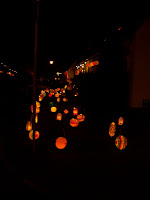
Magda and I were invited across the river to a part of Lahnstein known as Martins Siedlung (Martins Settlement), named after Saint Martin. This working class community was destroyed in WWII as was much of Lahnstein. It was rebuilt in the 1950s by the inhabitants. The homes that they built with their own hands, are small by today's standards and may not have the straightest walls or perfect corners. But each was on a plot of land big enough for a garden to feed the family (which makes such perfect sense for people coming out of the destruction of war). On Saint Martin's day, the people of this community decorate their fount lawns with candle-lighted paper and glass lanterns, many hand made. As night falls, the community comes out to greet each other and view the display of lights. At around 6:30, a parade begins. At the head of the parage is someone dressed as a Roman soldier riding a horse representing Saint Martin. Following Martin are the children of the community carrying paper lanterns and a band playing religious music. In former times, the children would sing songs praising Martin as they walked in the parade. But that is not true today, much to the chagrin of the older folks remembering their days in the parade.
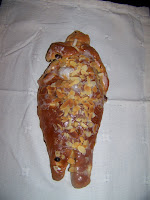
Children are given sweet bread, sometimes shaped as a pretzel or as a man smoking a pipe.
After the parade, the families retire to there homes to the traditional, working class meal for Saint Martin's Day in this part of tye world, Dippekuchen. This is like a giant German potato pancake that is baked in a cast iron pot. This one contained 5 pound of grated potatoes, bacon, onion, fleischwurst, eggs and spices.
As a final note, there is an awareness of our celebration of Halloween, that creeps into German celebrations at this time of year. Several of the houses were decorated with carved pumpkins. This is interesting because Martin was known for destroying pagan temples and structure. Here we have this symbol of a pagan celebration that has transcended its original meaning and is being used in the observance of a saint is interesting. But perhaps it is Halloween itself has made this transition into a holiday for kids, with no pagan or religious connotations to it.
The most repeated story about Martin occurred at the gates of Amiens when he and his soldiers came a scantly clothed beggar. Taking petty on the man, Martin cut his military cloak in half and gave half to the beggar to keep him warm. Why only half? Roman soldiers owned only half of their clothing. Martin could only give away what belonged to him, thus only half the cloak could be given. The story continues that Jesus came to Martin in his sleep that night wear the half cloak, telling the angels that the cloak had come from Martin.
I suspect there is a relationship between this separation of what belongs to the individual from what belongs to the state in this story of Saint Martin to a secondary, medieval meaning of the November 11. November 11 was when the serfs paid compensation to the nobles whose land they worked. 10 percent of everything produced in the year was payed to the nobility, be it grain, chicken, pigs or geese.
This fact and another story about Martin explains one of the traditional meals served on Saint Martin's day. When Martin learned that he was to be named the Bishop of Tours, he hid himself in a barn full of geese because he did not what such an honor. The noise from the geese gave Martin away and he was installed.
And so the nobles of the time ate geese to celebrate the day, as do a number of people today.
In this part of the middle Rhine, for working folk, the meal to celebrate the day is much more basic.
After the parade, the families retire to there homes to the traditional, working class meal for Saint Martin's Day in this part of tye world, Dippekuchen. This is like a giant German potato pancake that is baked in a cast iron pot. This one contained 5 pound of grated potatoes, bacon, onion, fleischwurst, eggs and spices.
Labels:
celebration,
customs,
food,
holiday
03 November 2009
Auf dem Jagd
9:40am and the blare of the hunting horns announce the gathering for the hunt to the small town of Greimersburg. This was a big hunt for the town. 93 shooters and 20 drivers had been invited for this hunt by the Dutchman that owns the hunting rights in this village. He had wanted to plan a large hunt to invite a number of his
friends from Holland to participate. They made up about half the shooters and drivers.
With the horns, the 113 hunters came together at the town community center to hear the rules of the hunt, first in German, then in Dutch. The hunt was to take place from 11:00am to 1:30pm. Effort should be made to take the injured or old. Be certain of you target before you fire, there are hikers as well as drivers and dogs out there. The primary game was wild pigs. Deer and foxes could also be taken.
Wild pigs have become a major problem in farming communities in Germany. These pigs are quite destructive to the farmer's crops. Their increasing population seems related to the increase acreage devoted to farming corn. Corn has not been traditionally farmed in Germany. It seems to provide the wild pigs with a food source and cover from hunters. More than one farmer has told us that the pigs like to go into the middle of a corn field and eat their way out, so their destruction is not noticed until too late.
And then again the horns, this time announcing the beginning of the hunt. The shooters were divided into groups, each group was a assigned a leader from the area. The leader was responsible for positioning the group members. After all the shooters had left for th
eir positions, the drivers where divided into 4 groups and positioned for the start of the hunt.
The land around Greimersburg is mostly cultivated. But there are some steeply sloping area where the forest has been allowed to grow. The set up for the hunt was classic. Shooters were position on the edges of these wooded area facing outward towards the surrounding fields. The drivers and dogs would work through the woods trying to encourage the game to move into the fields where they could be seen by the shooters.
At 11:05, the driver's for the group I was in fanned out along the road and entered the woods. For the nest 2 hours and 30 minutes, we moved in a line though the woods and berry patches that were in our way, periodically yelling "hup, hup, hup" to scare and pigs near by and to inform the shooters and other drivers of our position. Sometimes we would re-group to start another pass through the woods. As luck would have it, during all this time, we were only able
to see a single deer but it was moving too fast for the shooters to get a good shoot.
While we were unable to find the pigs in our area, we could hear shots being fired in the distance. Other groups appeared to have better luck.
At 1:20, our leader called a halt and we made a last pass in the direction of the autos. We loaded up and headed off to the hut to celebrate the hunt. At the hut, warm gulash soup and Zwiebelkuchen (onion tart) was waiting. We warmed ourselves by the fire watching each of the groups bring in their game. In all 12 wild pigs, 8 deer and 4 foxes were harvested.
In the ceremony that ended the hunt, each successful shooter was given a small branch from a pine tree. The meat from the harvest would be processed and sold to help pay for the hunting rights. The party was the real reward for the hunters. The drivers were given a little extra for their work, a kilogram of Dutch Gouda cheese. The sound of the hunting horns signaled the end of the hunt, but the party at the hut continues a while longer.
With the horns, the 113 hunters came together at the town community center to hear the rules of the hunt, first in German, then in Dutch. The hunt was to take place from 11:00am to 1:30pm. Effort should be made to take the injured or old. Be certain of you target before you fire, there are hikers as well as drivers and dogs out there. The primary game was wild pigs. Deer and foxes could also be taken.
Wild pigs have become a major problem in farming communities in Germany. These pigs are quite destructive to the farmer's crops. Their increasing population seems related to the increase acreage devoted to farming corn. Corn has not been traditionally farmed in Germany. It seems to provide the wild pigs with a food source and cover from hunters. More than one farmer has told us that the pigs like to go into the middle of a corn field and eat their way out, so their destruction is not noticed until too late.
And then again the horns, this time announcing the beginning of the hunt. The shooters were divided into groups, each group was a assigned a leader from the area. The leader was responsible for positioning the group members. After all the shooters had left for th
The land around Greimersburg is mostly cultivated. But there are some steeply sloping area where the forest has been allowed to grow. The set up for the hunt was classic. Shooters were position on the edges of these wooded area facing outward towards the surrounding fields. The drivers and dogs would work through the woods trying to encourage the game to move into the fields where they could be seen by the shooters.
At 11:05, the driver's for the group I was in fanned out along the road and entered the woods. For the nest 2 hours and 30 minutes, we moved in a line though the woods and berry patches that were in our way, periodically yelling "hup, hup, hup" to scare and pigs near by and to inform the shooters and other drivers of our position. Sometimes we would re-group to start another pass through the woods. As luck would have it, during all this time, we were only able
While we were unable to find the pigs in our area, we could hear shots being fired in the distance. Other groups appeared to have better luck.
At 1:20, our leader called a halt and we made a last pass in the direction of the autos. We loaded up and headed off to the hut to celebrate the hunt. At the hut, warm gulash soup and Zwiebelkuchen (onion tart) was waiting. We warmed ourselves by the fire watching each of the groups bring in their game. In all 12 wild pigs, 8 deer and 4 foxes were harvested.
Labels:
celebration,
customs
01 November 2009
The Hallows in Halloween
There is no organized celebration of Halloween as there is in the US. It has become recognized thanks at least in part to the commercial opportunity that it provides for stores to sell candy. Kids may visit family of close neighbors to beg for treats, but there is no organized "Beggar's Night" as we in the US associate with the holiday.
Rather, the primary holiday in Germany this time of year is the day the Halloween sprung from. The "Hallows" in "Hallows eve" that is the origin of Halloween refers to All Saints Day.
For Catholics, November 1st is All Saints Day (Alleheiligen) , a commemoration of the Saints and their sacrifices. This is followed by November 2 is All Souls Day (Allerseelen), a commemoration of departed relatives.
In Germany, the two are celebrated a single holiday, Alleheiligen, which seems to focus more on the departed relatives than on the saints. It is a day that people return to the towns and villages where their relatives are buried. The relatives' grave sites are cleaned and decorated for the celebration later in the day. This celebration consists of service in the nearby church or chapel, followed by a procession to the graveyards and a blessing of the graves. The blessing of the graves occur at dusk, lighted by the glow of the candles that have been placed on each of the graves. Afterward, families together in homes, often over 'kaffee und kuchen".
Labels:
celebration,
customs,
holiday
Subscribe to:
Posts (Atom)