Showing posts with label customs. Show all posts

05 January 2012

The Next Level in Parking Garages

1 comments
If you have driven in a German city of any size looking for a parking spot, you might have noticed signs like the one pictured here. The signs not only give directions to nearby parking garages, but also tell you how many places are available at each garage. The idea is to help save time, gas, traffic congestion and pollution by leading drivers directly to a garage with empty parking spaces.
Signs like these are possible because all the parking garages uses a similar system to control entry and exit from the garage. The driver pulls a ticket from an automat, thus initiating the lifting of the gate allowing the driver to enter the garage and then lowers the gate At the same time the automat is able to reduce the number of available parking spaces and transmit that to a computer to update the signs all over town. On returning to the garage to pick-up your car, the ticket is paid by inserting the ticket in an automat typically near the garage entrance. The automat figures the cost and displays it to the driver. Once the driver has paid, the automat marks the ticket as paid and returns the ticket to the driver. The driver then has about 15 minutes to find his/her car and leave the garage. At the garage exit, the ticket is inserted into a third automat. This automat lifts the gate allowing the driver to exit, increases the number of available parking spots, transmitting the change to a computer to update the signs and lowers the gate after the car has exited.

A new parking garage has opened in Koblenz that takes this idea to a new level. At the end of each row, there are two signs. One tell the number of parking spaces available in the row. The second tell the number of avail parking spaces if you continue further in the garage. Now in a nearly full parking garage, this is a pretty neat thing. No more driving down row after row looking for one of the last open spaces, hoping that someone else does find them first. But how is this done? I mean there are no gates on the individual parking spaces.
Well no, but there are sensors over each parking space. Here you can see that the sensor glowing red has detected our car in the parking space it monitors. Meanwhile, the sensor over the empty parking space next to us glows green.

31 December 2011

Dinner for One

0 comments
As I noted in a blog last year, watching the British comedy sketch "Dinner for One" is a New Year's Eve tradition in Germany. The film is broadcast on a number of television stations at different times during the day. Here is a link in case you want to join the annual fun.


25 December 2011

Weihnachten 2011

0 comments
Christmas Tree with lighted candles

The candles on the Christmas tree were lit last night in accordance with the Christmas Eve tradition in this part of the world. We did make a small compromise to tradition this year. While Magda's family tradition holds that the tree is not even put up until Christmas Eve, this year we put the tree up 5 days before. But it was not decorated until Christmas Eve. That was done just to eliminate the need to go out on the streets on the last shopping day before Christmas.

Homemade presents for 2011
Homemade Liqueur
 We did make some homemade gifts for friends and family this year. Three types of liqueur were bottled. These were made from red vineyard peaches, black currants and pears. We were particularly happy with the pear liqueur, probably because were did not have high expectations. But it turned out with a very nice pear flavor.

As mentioned in the previous blog, we made Christstollen according to the recipe out of the 1939 cookbook. But that was not the only baking we did. We put together packages containing 8 types  of cookies. These included Tollhouse cookies because, as every knows, they are Santa's favorite (although they are not seen here in Germany much).

Tollhouse
Snickerdoodles
I also did Snickerdoodles this year as another example of a traditional American cookie. Yes, I know that the Wikipedia page for Snickerdoodles claim a German origin for these cookies, but I don't buy it. I have never seen Snickerdoodles in a German cookbook, nor are they easy to find on Germany cooking web sites. When I have found something call Snickdoodles, they are quite different, containing walnuts and raisins, than the simple sugar cookie rolled in cinnamon and sugar that is typical in the USA.

Magda is a big fan of shortbread, so those had to be included. And what would Christmas be without some cut out butter cookies?.

Add the these some traditional German cookies. Lebkuchen almost defines this time of year in Germany. The ones we made are, like our stollen, based of a recipe from a 1939 Dr. Oetker cookbook. Honigkuchen uses the same spices as Lebkuchen, but uses honey as the sweetener and does not use much ground almonds. Heidesand is a personal favorite. It is a butter cookie with a little marzipan mixed in. They are formed by rolling the dough into a log, covering the outside of the log with sugar and slicing off the cookies. And Schmaltznüsse are a shortbread cookie where half the butter is replaced by lard. In this case, coca powder was added to half the recipe to create the "black and white" Schmalrznüsse.

Frohe Weihnachten!

Butter cookies and Shortbread
Homigküchen

Heidesand


Lebküchen

Black and White Schmalzmüsse

11 November 2011

Making Christstollen, a November Tradition

0 comments
Despite the increasing number and size of the Christmas displays that have been appearing in stores since the beginning of September, I have managed to avoid thinking too much about the coming Christmas season. However, Mid-November is time to start thinking about Christmas baking. While Stollen, the German sweetened bread with nuts, raisins and citron that is very popular at Christmas, can be eaten fresh, it actually is better when stored for a few weeks. The general rule of thumb is to bake Stollen at least 4-6 weeks before it is to be served. So now is the right time to start baking it.

I use a recipe that I have adapted from the Dr. Oetker's Schulkochbuch (School Cookbook) from 1939. Dr. Oetker is sort of the Betty Crocker of Germany. Maybe even bigger in Germany than Betty Crocker is in America since in addition to a historic line of cookbooks, the company also sells cooking ingredients. This year, the Schulkochbuch is celebrating 100 years of publication with its 10th edition. Each edition is a bit different, reflecting the tastes of its time. I like using the 1939 edition (the 3rd edition) because the amounts of sugar and fat used in its recipes are much less than a recipe from current cookbooks. I suspect this is because these ingredients were much more expensive at that time.

The recipe is called "Simple Christstollen". I'll first give the recipe from the book (not a literal translation) and then provide additional insights to the recipe as well as some of the variations that I've used.

Simple Christsrollen
100g Schmaltz
100g Butter
125g Sugar
1 Egg
1/2 container of Dr. Oetker's Lemon Backoil (Backoil is explained below)
500g Flour
1 package Dr. Oetker's Backin
1/4 cup Milk at room temperature
125g Raisins
50g Currants
50g Citron
50g chopped Almonds or Walnuts
  • In one bowl, mix the fat, sugar, egg and backoil until creamy.
  • In another bowl, mix the flour and the backin.
  • To the fat/sugar mixture mix in 3/4 of the flour mixture and the milk to form a wet dough.
  • Knead in the raisins, currants, citron, nuts and remaining flour until the dough accepts the remaining flour.
  • Form a stollen and place on a flour covered baking sheet.
  • Optionally after baking, drizzle with a little additional butter and sprinkle with powder sugar.
  • Backing time: 1-1.5 hours in middle hot oven.
Schmaltz is rendered pork fat. It is cheaper than butter and doesn't have a distinct taste. So mixing with butter is quite frugal. Using all butter is fine, as would using margarine.

Backoil is flavoring that is used in baking in Germany. Personally, I find it artificial tasting, especially the lemon and orange flavors. So I prefer using the zest of one lemon.

Backin is German baking powder. It is sold in packages containing 5 teaspoons. This is different than the American baking powder and should not be substituted for each other. Some specialty grocery stores will have packets of Dr. Oetker's Backin (the Andersons in Columbus carries them, or you can find it on Amazon). If not, a reasonable substitute is a 2 to 1 mixture of cream of tartar and backing soda.

A lot of people prefer yeast as the rising agent (Magda is one of these). I've used both fresh and dried yeast in place of the backin quite often in this recipe, but doing so means giving the yeast some time to work. I give the yeast a good start by mixing it with the warm (but not hot) milk, and a little bit of the sugar and flour from the recipe about an hour before getting started. This mixture is added with the 3/4 of the flour mixture to form the initial dough. Once fruit and remaining flour is kneaded together, I leave the ball of dough to rise in a bowl covered with a towel for about 2 hours. Then after forming the Stollen, I cover them with a towel and let rise for an additional hour before baking.

Most any dried fruit can be used in place or in addition to the raisins and currants.For example, I've used dried cranberries several times. I do like to soften the fruit a little by soaking in a liquid for a couple of hours. Rum or orange liqueur would be traditional liquids. Orange juice would also be OK, if staying away from alcohol is important. 

Forming a stollen simply means rolling the dough in to a thick oval, the length of the loaf that you want, and lengthwise folding one side of the oval over the other. Let the bottom part hang out a little bit, you don't quite want the top part to cover it completely.

The recipe makes a 1 kg (a little over 2 lbs) Stollen, which is a pretty good size loaf. 2 half kilogram (1 lb) Stollen may make more sense if you are planning to serve groups of 3 to 5. In the pictures below, I made 4 small Stollen that would be just right as a gift to a single person or a couple.

For a number of reasons, bake temperature and time are always a problem when using old recipes. The idea is to bake until the Stollen are golden brown. I use the over and under heat setting on our oven. What I do is pre-heat the oven to 190 degrees C, and then turn the oven down to 175 C when I put the Stollen in. Bake time for the 1 kg Stollen is 40 to 45 minutes. If you make 2 or 4 smaller Stollen, the bake time will be a little less. Obviously, if you use convection, you should reduce temperatures.

12 September 2011

Too Early for Me

0 comments
While doing my shopping rounds last Saturday, I stopped in the local Aldi for a few staples. As a rounded to corner to head towards the paper goods, I was confronted by a display 1.3 meter wide, 3 meters long and 1.5 meter high of Christmas cookies and other backed goods.
Taken from Norma's Ad starting Sept. 12

The Sunday, I packed up the week-end ad for another grocery store in the area, Norma, and they were advertising Christmas cookies. You can see part of the ad here. Yes, those are Christmas tree ornaments behind those Nürnberger Lebkuchen.

Maybe it just me and others have a driving need for lebkuchen in early September. Or maybe I'm becoming a bit more like Ebenezer Scrooge as I age. But I for one can wait until at least November before feeling it necessary to satisfy my annual cravings for Nürnberger Lebkuchen.

10 March 2011

Karneval in Koblenz

0 comments
The days prior to Ash Wednesday and Lent have different names in various parts of Germany. In and around Koblenz, they are called Karneval. Although the Karneval season officially begins each each at 11:11 on 11/11. This is when Karneval prince and princess are anounced and the Karneval clubs begin their planning for Karneval celebrations, including figuring out their theme for the coming celebrations, preparing their costumes and float, and planning their parties.

The actual Karneval celebrations begin the Thursday before Lent with "Schwerdonnerstag" (Hard Thursday). Many businesses close at noon, schools arrange in-service days so that the students don't have to be in school. Things begin with a symbolic storming of the city hall by the Karneval clubs. With the club members in costume, firing confetti cannons, the Karneval Prince demands the key to the city from the mayor. Women take the lead the rest of the day. Some women will go around carrying scissors, cutting off any ties worn by men on this day. At the parties later, women choose their dance partners.In fact, some folks refer to this day as Weibekarneval (Wife's Karveval).

Parties continue on Friday and Saturday. The foods most associated with this time of year are Berliners and Naunzen. Berliners would be recognized by Americans as a jelly doughnut, round pieces of yeast dough that are deep-fried, filled with jelly and sprinkled with sugar. Naunzen use the same dough as Berliners and like Berliners are fried and sprinkled with sugar, but unlike Berliners, are irregularly shaped and are not filled. By the way, Berliners are root of the Urban Legend that JFK called himself a "doughnut" when he said "Ich bin ein Berliner" before the Berlin Wall in 1963. In truth and in that context, there was no confusion for Germans. A Berliner is also a resident of Berlin and use of the adjective "ein" placed an emphases on his oneness with the people of Berlin. Exactly what he was trying to say. It remains a moment remembered in German history books and has a display devoted to it at Bonn's "House of German History".

On Sunday, parades get added to the entertainment. In our village of Wallersheim, there is a kids parade. Although I'm not sure what makes it a kids parade, other than the selection of the parades prince and princess, who were young kids. There are more adults than kids in both the parade and audience. A good percentage of the audience, young and old, are in a costume. And certainly, beer and wine are flowing in both groups. As the parade passes, everyone waves a hand over their head and shouts the greeting for Koblenz, "Oula" (in other parts of Germany the greeting would be "Hela").

Whereas in other parts of Germany, the celebrations are still rooted in the idea of scaring away the evil spirits of winter (see last years post on Fastnacht in southern Germany). The Karneval parades in this part of the country tend to be about political satire or current topics. Sort of reminds me of the Do Da parades on the 4th of Jully in the USA. This is one reason that even today many of the clubs still dress in costumes inspired by French or Prussian military from the 1700s. Karneval was used  as an opportunity to make some fun of their occupiers back then. This year, the current topic in Koblenz is the the upcoming national garden show, BUGA. So it is no surprise that to see a lot of costumes and floats with flower themes in this year's parade.

Smaller towns and villages have parades on either Sunday or Tuesday. Rosenmontag, the Monday before Ash Wednesday, is the parade day for the larger towns. Cologne's and Mainz's parades are shown on TV. In Koblenz, the parade attracted 100,000 watchers this year. Prior to the parade, the downtown was closed off to traffic and special buses carried people to and from the parade.

06 February 2011

Hochwasser and The Lady Gets Another One

0 comments
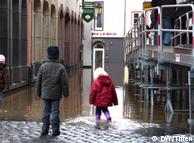
During the middle of January, we where experiencing flooding along the Rhine and Moselle. Neuendorf and Wallersheim (where we live) was particularly hard hit as they are the villages just below the confluence of these two rivers. The waters reached the 7.5 meter mark, well below the record flood levels of around 9.5 meters. but still enough to cover the first story of most of the homes along the Rhine. Our building is high enough that were relatively unaffected. However, Franny did have to experience a change in her routine walks.

For many affected, this was nothing new. The fire department came in before the flood waters reached the town and build walkways allowing people to access the second floor of their homes. People along the river have learned to live mostly on the second floor anyway. Rooms on the first floor only contain furniture that can easily be moved to the second in case of floods. Cars were moved to parking areas on higher ground. And many people stayed in their homes.


Probably the most disruptive event occurred on the Rhine, a few miles upriver, at the base of the Lorelei cliffs. This is a place where the Rhine river narrows and turns as passes around the cliffs. As long as the Rhine has been used by boats, the swift water and turn on this particular section has been a problem for boat captains. The accidents gave rise to the legend of Lorelei, the naked siren with cooper hair that would sign such a beautiful song that she would boat captains into a accident in the swift waters.
 

On January 18, Lorelei got another. This time it was a tanker, the TMS Waldhof,  carrying 2000 tons of sulfuric acid. The big problem here is that the combination of sulfuric acid and water can be explosive, and a couple of the tanks developed leaks that was allowing water into them. It took awhile to get the necessary equipment into place to stabilize the situation. During this time, boat traffic was not permitted along the river at this point, and detours were set up for auto route along the river.. Many boats have had to dock and wait until it was safe. That occurred on Friday morning around 9:30 am. The Waldhof is still in the water, but the tanks have been drained and it is now safe to continue the rescue.


31 December 2010

New Year's Eve Tradition: Dinner for One

0 comments
Dinner for One is a New Year's Eve tradition in Germany. It is actually from British TV, but it is played on several German TV stations at different times during the evening. This video has a 2 minute introduction in German, before the actual show begins.

25 December 2010

Signs of Weihnachten: Weihnachtsbaum

0 comments
According to the custom of Magda's family, we decorated our Christmas tree the morning of Christmas Eve. Once again we went with the straw ornaments, some of which Magda and her sister made as kids. Plus a few Santa Claus ornaments made of oyster shells by friends from Hilton Head. The lights are real beeswax candles. Of course this was on a real tree. Artificial trees are not unknown here, but there use seems restricted to businesses and not in the homes.

While a few people put up their Christmas trees earlier in the month, a most seem to wait like we do. In fact many of the stands that sell Christmas trees didn't even open until the beginning or middle of last week. Often these stands are run by a family that grows the trees on their farm in the Eiffel. They cut their crop of 50 or 100 trees, bring it into town and sell it out in a couple of days.

The tree stays up at least until after Jan. 6th, the "Tag der Heiligen Drei Könige"(day of the three kings). Some will keep them until Lichtmess on Feb. 3rd. Traditionally in addition the Christmas tree, "Krippen" (nativity scenes) are also taken down on this day.

22 December 2010

Signs of Weihnachten: Weihnachtsmarkt

0 comments
We lit candle number four on the advents wreath on Sunday. That means there won't be any more Sundays before Christmas.

We did take a little time out on Saturday to visit a Weihnachtsmarkt. Last year, we had heard from a neighbor that Ahrweiler had a pretty and pleasant market that was worth a visit. Ahrweiler is a small town on the Ahr river about 30-45 minutes from us. The Ahr river is Germany's northern most wine  region. It is know for it's red wines that rarely get exported, being mostly bought up by folks from Bonn or Cologne that visit on week-ends. We use to hike here quite a bit, but it had been several years since we were here. And I don't recall spending much time exploring Ahrweiler.

So it was with some surprise that we discovered this well-persevered town. There is still a defensive wall around the town, a legacy of medieval times that has been restored and/or rebuilt. Inside the wall are pedestrian only streets with half-timbered houses on either side.

The main part of the market was in the marktplatz with Ahrweiler's the Gothic church St. Laurentius providing a backdrop.

The Ahrweiler Weihnachtsmarkt is a week-end only market, so it does attract the kinds of crowds that markets in the larger cities attract. This was locals and people on a week-end getaway enjoying the day shopping the stores in the town, checking out the booths in the market, and having a glass of glüwein while standing by a fire and chatting with friends. It was a pleasant atmosphere.

The other nice thing about this market is that a number of the booths were selling local or handcrafted products. So often, Weihnachtsmarkts are filled with people selling the same products that you can buy in the store, and often without much of a discount. There just are not enough handcrafters to handle all of the Weihnachtsmarkts that have sprung up in the last few years. Ahrweiler had enough to be interesting.

16 December 2010

Signs of Weihnachten: Getting in the Mood

0 comments
Last Sunday we lit the third candle on our Advent wreath. One more candle to go. I suppose that should be a pretty good hint that Christmas is comming.

We also brought out the Christmas pyramid this week and got some candles. That are a couple of videos of the pyramid in action that I've attached to the end of the blog entry.

Magda's tradition is to put up the Christmas tree on Christmas Eve. That is not a problem this year since her school doesn't let out until the 23rd this year. I can't imagine that we would try to put one up much before then anyway.


But I have to say that the thing that has done the most to make me become aware of the upcoming holidays was the purchase of some tea last week. Of course, we are not talking just any tea here. We talking about Weihnachts tea. This is a black tea (Ceylon) with cinnamon, orange peel and almonds added to give the taste and smell of the season. Weihnachts tea is a long-standing tradition here in Germany and also in Great Britain this time of year. It is funny how the taste or smell of something can make you more aware of an event than all the things you see around you.


07 December 2010

Signs of Weihnachten: Starting the Countdown

0 comments
This year the real countdown to Weihnachten started on November 28, the 4th Sunday before Christmas. The custom is to set up a wreath with four candles. Each Sunday leading up to Christmas, a new candle is lit. This picture was taken last Sunday, the second Sunday of Advent.

This is also the week-end that the house exteriors were decorated. Since this is a neighborhood with a lot of apartment buildings, mostly this involved placing lights in the windows. But some people do go a bit further that that. But by comparison to the US, the decorations are pretty tame.

December 1 begins another count down. That is for the advents calendar. Typical Advents calendars involve a narrow cardboard box that can be hung on a wall. There are 24 numbered doors in the box. Each day, one of the doors are opened to reveal a treat. Once all the doors are opened, it is Christmas Eve.

Our Advents calendar this year is a little different. We slide out a piece of marzipan each day from the bottom, revealing a new fact about Weihnachten printed on the inside of the box. And, oh yeah, leaving us with a piece of marzipan to enjoy.

December 6 was Saint Nicholas Day. Saint Nicholas lived during the 3rd century in present day Turkey. A child of wealthy parents who died while Saint Nicholas was still quite young, he used his wealth in secret gift-giving to deserving people. So today, kids in Germany wake up on December 6th to find small gifts (typically sweets) at their front door. Actually not just kids find gifts. People will door small gifts at the door of friends that have helped them through the year. We actually took a Saint Nicholas run the evening of December 5th to drop off some bags of cookies at the door of 3 such friends.

05 December 2010

Signs of Weihnachten: September thru middle of November

0 comments
Thought it might be interesting to take a look at the build up to Weihnachten (Christmas) that we are experiencing here. To do that though, it is necessary to go back a couple of months. The first signs of Weihnachten started showing up in early September this year. That was when the grocery stores here put up big displays of Christmas cookies, candies and cakes. Lebkuchen (Germany's gingerbread), zimtsterne (cinimmon stars). spritz cookies, and, of course, stollen began filling the shopping carts of Germany.

Groceries followed in early October with displays of baking goods. This was combined with advertisements about the importance of starting your Weihnachten baking early. The things offered for baking are truly amazing, and they are in even the cheapest of grocery stores. Hazelnuts, walnuts, almonds, blocks of marzipan, melting chocolate, pre-made spice mixes for lebkuchen and spekulatius, hirschhorn (an ingredient for springerle), pre-made marzipan cookie decorations to made just a few of the items.

The department stores got into the act in mid-October putting up their displays of Weihnacten decorations.

Mid-November, began the big push of table decorations. Holiday themed table clothes, napkins and other decorations hit the market, as well and opportunities to buy new vine glasses, tableware, and dishes for the holiday table.

Five weekends before Weihnachten, the Weihnachtmarkts opened. In Koblenz, the Weihnachtmarkt is located in three marketplaces in the Altstadt (old part of town). It seems more about food and the sale of manufactured items, than about individuals selling handmade items that was the basis for the tradition. But still it brings some light and fun to the town in the evening at a time when it is getting dark at 4:00 pm. Plus there are an occasional shop that offering the kind of handmade items that you expect to find.

25 November 2010

Germany's November Bird

0 comments
Although it is a relative recent addition to the German menu, Germans do like turkey. It is however not often roasted as a whole bird. Happily, we are able to buy whole turkeys in the groceries this time of year. Also everything that is needed for the trimmings, including the dreaded cranberry. But I think this is because there are enough Americans (and curious Germans) living here to create a market at this time of year.

For Germans when it comes to roasted poultry in November, the bird of choice is goose. From the end of October you see frozen goose being offered in the grocery stores. Butcher shops ofter the ability to order a fresh goose. Restaurants have been advertising goose dinners. This reaches a climax each year on November 11th, put does continue through the end of the month.

One reason for this tradition dates back to the 4th century B.C. St. Martin day is November 11th. Legend has it, that upon hearing that he was to become the Bishop of Tours, St. Martin hid in a goose barn because he felt himself unworthy of the honor. However the honking of the geese gave St. Martin away. So the goose has been associated with St. Martin. There is an alternate legend to explain the association of the goose to St. Martin. According to this legend, a goose made so much noise during a service that St. Martin held that it annoyed the saint. As a result, that goose ended up on the table that evening.

In the 6th century, several things came together to secure the goose a place on the table for November 11. First it had become the beginning of 7 weeks of fasting between St.Martins day and Christmas. So a good meal was important. Second and perhaps related, November 11th had become the end of both the financial and farming year. So at this time of year, livestock that would not make it through the year was slaughtered and preserved. Geese would never be so plump as at this time of year. Peasants had to pay 10% of their production to the landlord. What they ate beforehand would not be counted. Still the landlords were receiving an abundance of geese that would not survive the winter. But as it was the end of the financial year as well, the laborers and handmaidens were dismissed on this day and new ones hired for the next year. Landlords would give the dismissed employees a goose as a gift. All this conspired to make a lot of geese available for the November 11th table.

We did have goose one evening at a restaurant in Badenweiler. The traditional trimmings served in Germany with the goose are rotkohl (red cabbage). klöse (potato dumplings), apple sauce and roasted chestnuts. The spätburgunder (pinot noir) was a nice accompaniment.

01 November 2010

German Breakfast

1 comments
Magda has been home from her school's exchange for about a week. Although the German students are getting together later this week to discuss there experiences, I've heard a few of the things that the German students thought about their stay in the Chillicothe, Illinois. One oft-commented impression was that their American families rarely took time to lay out a breakfast. Everyone seemed to be on their own to grab something quick, or to skip breakfast entirely. It is not that the German students expected the family to sit down together every morning to eat. What was generally surprising was that no one took the time to lay out the meal, if for no other reason than to make sure the kids are eating something and eating healthy.

The picture here gives an idea of a typical breakfast for these German students. There is usually some sort of meat or cheese. In this case, there are cheese slices, two types of salami and some schinken (smoked ham). Just about any kind of sliced meat is possible, but the meat is thinly sliced. Germans will talk about a "window pane" slice especially with highly flavored meats like schinken. This refers slicing of meat that is thin enough that you can see through it. This way, you really don't eat much meat or cheese.

The meat, cheese or jam is placed on a slice of bread or a half of bread roll, often buttered, to make an open faced sandwich. There are so many bread choices in Germany that it is hard to fathom. In this picture are a couple of rye rolls and a pumpkin seed roll. Darker breads based on rye are more traditional, but white rolls, which use to be reserved for special occasions, have become more common.

This picture also shows yogurt and quark. Quark is a bit like cottage cheese, but it is in the form of a single cake, rather than small curds. For breakfast, it is used like yogurt, mixed with jam. But quark is also used to make cheese cake, dips, fillings for pasta or sweet rolls. It is really an inexpensive staple of the German pantry.

Finally there is some sort of fresh fruit available.

There are some variations possible. For instance, a lot of people like to mix muesli with yogurt or milk for breakfast. Milk and corn flakes (or some other breakfast cereal) is an American contribution to a "typical" German breakfast. And yes, sometimes a sweet roll can be found, although donuts are very rare.

But that leads to another surprise for the German students. Things like sweet rolls, cakes, cookies and other pastries were too sweet in the USA for them to enjoy. Certainly we have found that in adapting a American recipe for use here, we often cut out at least half the sugar (and often two thirds) to get something that our German friends and family can enjoy.

19 October 2010

Rite of Fall: Collecting Walnuts

0 comments
One of the rites of fall here is collecting walnuts. Usually we will do this on our hikes around Badenweiler in southern Germany. In this area, there are many walnut and fruit trees that are left unharvested. We actually end up returning with heavier packs than we started with, plus our pockets are full as well.

Unfortunately Magda was forced in participating in the exchange between her school and the high school in Chillicothe, Illinois, due to the "illness" of one of the teachers who had originally signed on for the exchange (excuse my skepticism, but it is hard to understand why the success of an English language exchange depends on a part-time teacher who only part-time teaches English. Where are the teachers who teach English full-time?). So I have been picking up some walnuts under a couple of trees in the park that Frannie and I often walk. Usually we find a handful of nuts on each walk, but over time, as you can see, that can grow to a reasonable amount.

The walnut trees here are not the black walnuts that we typically see in Columbus, Ohio. Rather they are English walnut trees. One big difference is that as the nut ripen, they separate from their green cover. Sometimes they seem to spring from their covering and landing a fair distance from the tree. This makes them much easier to collect and make use of.

Around Koblenz, the walnut trees seem to grow best in the micro-climate of Rhine and Moselle valleys. It is usually just too cold and windy in the fields of the Eifel and Hunsruck (there is often a 5-8 degree C difference between Koblenz and the Eifel). The occasional tree that you find there are mostly in the villages where they are protected some from the climate. Further south, around Badenweiler, they can be found every where.

A couple of weeks ago, when the nuts started to ripen, there was quite a bit of competition for them. Every day there would be older couples and younger families out collecting the nuts from the trees in the park. Some would just pick up the nuts from the ground, but others were impatient and threw prices of wood into the the trees to try to knock the nut down. Now that we are at the end of the harvest, the competition has lessened. But still there are enough that I'm able to collect a new handful with each walk.

By the way, the green decoration on the nuts are hops. Hops grow wild here as well. I have noticed them on the banks of the Rhine and along the trail in the Eifel.

26 September 2010

Jam from Red Vineyard Peaches

0 comments
One of the unusual fruits that ripen this time of year is the "roter Weinbergpfirsich" or red vineyard peach. This is a red flesh peach that is grown in vineyards along the Moselle. It is not a particularly sweet peach, but is highly prized  by some for its use in jams, liqueurs and compotes. We picked up a couple of kilo and made a really tasty jam with them and in the process learned a thing or two.

First is the juice from these peaches is a really intense red. Peeling these peaches results in red hands, and if not careful ruined clothes. The hands can be cleaned with the use of lemon juice. But use of the clothes will be limited to working around the house (voice of experience here). But this is also what gives you this ruby colored result.

The other interesting thing is learning how homemade jams are done here in German. It seems a more popular hobby there than in the USA, at least it appears that more shelf space in the grocery stores seem to be devoted to it than in Columbus. We used one product that I haven't seen in the USA. This is a sugar that already has the pectin mixed in called Gelierzucker. Gelierzucker is offered in two strengths, 2:1 and 3:1. 3:1 Gelierzucker would require a 3 to 1 ratio by weight of fruit to sugar to make jam.  It only requires 3 minutes of boil for the jam to set. Cannot get much simpler than this. Peel and stone the peaches, weigh the resulting flesh, divide by three, add that much Gelierzucker, bring to boil for 3 minutes, put the jam in your jars.

These peaches should be available for a couple more weeks. I would still like to try making a peach liqueur before the season ends. Magda claims that once you have a fruit compote made with these peaches, you won't want to use any other fruit. So we will have to try that too. But more on that later.

11 September 2010

In Search of Edible Stones

1 comments
This week we had an opportunity to connect with our common hunter-gatherer past in doing a activity that while it is not common, it is practiced more widely here in Germany than in the USA. That wold be mushroom hunting.

The idea started at the 70th birthday party of Ulrich, one of Magda's friends. As we were talking,  Ulrich mentioned that on a walk the previous week he had started to collect Steinpilz in the last week and that there were few things better than Steinpilz in a cream sauce over pasta. Before I had a chance to say anything, Magda jumped in saying how she would love to go with him one day to learn about collecting. And so, a few days later, we arranged to do just that.

Steinpilz (literally translated as "stone mushroom") is perhaps the most desirable of Germany's  edible wild mushrooms. They are a large, meaty mushroom. The best comparison in terms of consistency and taste that would be common to Americans would be the porcini. However, they are different mushrooms. Steinpilz is only one of the many varieties of mushroom than one can find in the German forest, some of which of course are poisonous. But there are a wealth of edible ones and until recently it was common practice for Germans to go out to collect then.  Magda actually showed me the text of a biology book from the 1970's. The book taught mushroom identification so that people could learn how to safely collect them. Some of the mushrooms mentioned include the following:
  • Ziegenbart which looks, as its name suggest, like the beard (Bart) of a goat (Ziegen) sticking out of the ground. However, ziegenbart is a "giftig" which has nothing to do the the English false friend "gift". "Giftig" means toxic.
  • Parosolpilz is a pretty mushroom that grows taller than most on a slender stem with a dome-shaped cap. Ir looks like an umbrella sticking in the ground.
  • Pfifferling are what we call chanterelles. It is also one of the most sought after edible mushrooms in Germany.
  • The red skin of the cap of the Täudling would make you think it is toxic, but it is not. According to the biology book, it tastes like a potato.
But we were after the German king of edible mushrooms, Steinpilz. We meet Ulrich in his village, Lay. Lay is on the Moselle, not far from Koblenz. We took the trail up out of Lay to where the trail entered a old deciduous forest. This would be out hunting grounds. We headed off the trail in search of our prize. Stienpilz is a fairly large mushroom with a skin that starts dark brown and gets lighter as the mushroom ages. Stienpilz does not use gills to release spores, rather a system of tube like structures that give the appearance of a sponge under the cap. Another distinguishing characteristic is the shape of the stem. It become thicker at the base as compared to where it meets the cap.

It wasn't long before we started to find a few, enough for dinners for two families.  Our haul can be seen in the first picture. It was also fascinating to see the great array of mushrooms that you just would miss if you stay on the trail. We saw a number then that were mentioned in Magda's biology book, and a few that weren't. The one that had the most fun off the trail was Frannie. She just seemed in seventh heaven running from place to place and sticking her nose in the leaves for some new smell. It might be a while before we can get her trained to be a mushroom hunter.

Dinner as you would expect consisted of the meal that started this whole adventure, Steinpilz in a cream sauce over pasta. Hardest thing about it is cleaning the mushrooms. Snails also like Steinpilz, so you want to be sure to cut away from around where snails have taken a bite. Saute onions and bacon until the onions begin to soften. Add the mushrooms and cook until they are soft. Then add the cream, season and add a bit of fresh parsley. Serve with pasta. The Spatbugunder (pinot noir) that we had worked great. But a dry Moselle Riesling would also work well. Guten Appetit.

14 August 2010

Freiburg, August 2010

1 comments
Generally speaking, I have a more of a preference for the villages and countryside of Germany than I do the cities. In fact, I think I can say that about most countries that I have visited. I just think that is were you find the soul of the county.

However, Germany is blessed with a number of cities that have a sense of uniqueness to them making a visit worthwhile. One of those cities that we keep going back to is Freiburg. Freiburg, on the western edge of the Black Forest, is the major German city in the southwest corner of Germany. It was established around 1120 as a fortified market town of free citizens. This is the basis for the name of the city ("frei" meaning free and "burg' meaning a fortified citry). The city holds on to its roots as a market town in a couple of ways.

First there is a large market around the Freiburg Munster, Monday through Sunday. When we were there on a Tuesday at the beginning of August, I would estimate 30 framer stands selling fruits and vegetables, 4 selling flowers, another 2 stands selling meat, 4 stands selling cheese, 5-6 selling prepared food, 2 selling carved wooden items (a black forest specialty), and another 5-6 selling other items. Really a good size market, especially for an every day market.

The other connection to the roots as a market town is the availability of department stores and shops in the city. Freiburg has a huge pedestrian area that is lined with such stores. Shopping in Germany can be interesting. The sales people in the major department stores tend to be professionals who have been doing their job for quite a while. Many can look at you and tell you what your size is. Not only that they will know there stock and know if they have something that might be the right cut and color for you. If you try something on that is not a good fit or color, they will tell you and suggest you try something else. If they don't have anything, they will let you know that they have nothing that they can recommend.

The church at the center of Freibug is called referred to the Frieiburg Munster. Munster means that it is a major church but is not the seat of a bishop. However, this church has been the seat of archbishop of Freiburg since 1827 and therefore could be referred to as a cathedral. The church in transitional, having been started in 1200 as a Romanesque church but with construction switching over to the Gothic style about 1230. Although the tower is currently under reconstruction and is covered by scaffolding, I know from past trips that the climb to the top is well worth the effort for it's 360 degree views and the close-up look at the intricate stonework of the belfry.

There are a number of other reasons to like this city from the gutter system that dates back to the middle ages to support the fighting of fires, the remains of the wall that fortified the city,  the late Gothic Merchant's Hall and the City Hall from the 16th century, to the restaurants along Munsterplatz that have outdoor seating allowing you to enjoy a beer or glass of wine in the shadow of the Munster anytime of the year (in winter, each chair has a blanket or a sheepskin that you can wrap up in). Freiburg is also has one of Germany's oldest universities, which adds to the vibrancy of this city.

26 July 2010

Nice to be Home in Columbus

0 comments
It has been awhile since my last post, partly because Ive been in Columbus for about 3 week. Spending the time in Columbus has got me thinking about some of the things that I enjoy about being here. So on the eve of my return to Germany, I thought it would be fun to mention a few of them.
  • Chillin' on my front porch in one of our Adirondack chairs on a summer morning before the heat of the day sets in is one of the things that feels so right. In Germany, we have a 1 meter by 5 meter balcony with awning, quite a bit smaller than my covered 10 foot by 30 foot poach. Plus,being on the street level here surrounded by 80+ year old homes and trees, you feel more connected with the neighborhood than from our 4th floor balcony in our 50 year younger German neighborhood.
  • Grillin' on the back deck is another thing I truly enjoy when I'm in Columbus. We are not allowed open flames on the balcony in Koblenz. Some people use electric grills, but that fails to satisfy on some primal level. Here, I'm able to carry a plate of meat right from the kitchen less than 10 steps and slap it on the grill over open flames. That's satisfaction.
  • It certainly is nice meeting with longtime friends. Of course when meeting friends from my previous work life, it is also nice not being personally effected by the latest management efforts to push ahead on a product or get control of the workplace. That's all behind me.
  • Did I mention that we lived on the 4th floor in Germany. That means four flights of stairs between us and our freezer and wine rack in the basement.  You want rolls for breakfast, down 4 flights to the freezer and back up. You want meat from the freezer for dinner, down 4 flights and back up. Bottle of wine with dinner, down 4 and up. In Columbus, worst case in one flight to the wine rack in the basement. I must say there are a couple of advantages to the arrangement in Germany. I certainly helps with fitness. Plus it rewards a bit of thinking ahead.
  • Air conditioning on 90 degree days is nice. I'm not a big fan of air conditioning. I actually turn it off when I can. But when the temperatures get above 90, it goes on. Not many folks (us included) in Germany have it. 90 degree days don't happen very often there, although in the last couple of years there have been 4 or 5 days per year. On those days, we just have to suffer (or go to the movies).
  • Roads and cities here are designed for autos. The lanes are wider, and there are not the same kind of twist and turns that are needed in Germany. Plus there is parking near the most stores in Columbus. Road surfaces in Germany are actually better than in Columbus though. But parking in German is usually at meters on the street or in relative expensive parking garages.
  • Clothes prices in Columbus look so cheap. I don't know what it is, but I can buy designer label clothing here much cheaper that any label clothing in Germany. It is tempting to fill the bag with clothing for a year. Too bad there is that 40 kg weight limit.
  • There is a comfort associated with command of the language that I feel here, and am missing in Germany. While learning a new language is fun, there are times you just love being able to express yourself fully. Like that cell phone salesman at the Saturn store in Koblenz that treated me like an idiot when I asked a couple of question about using a phone they had on sale with my current contract. I would have loved to have had full command of the German language to let him (and perhaps his manager) know what I was thinking. Here, in Columbus, I won't have that problem.
  • Morning newspapers are a nice addition to chillin' on the front porch. The tradition of the newspaper in German is a bit different than in the USA. Not so many folks take the daily paper in Germany. Still, it is sad to see what is happening to the American newspaper. And with the recent increase in the price of a Columbus Dispatch subscription, I think it is only going to get worst. But while they last, I, for one,do enjoy them, especially Sunday mornings.