18 July 2011

Little Switzerland

0 comments

Little Switzerland refers to the region on either side of the Sauer river that defines the border between Luxembourg and Germany. This region with its rocky outcrops, craggy terrain, thick forests and small streams resembles, at least to some, its namesake country. One big difference is altitude. The highest elevation in Little Switzerland is 414 meters above sea level. Compare that to 4634 meters for Switzerland.

But this comparison should not be viewed as a negative. In fact for the average hiker, Little Switzerland might be more enjoyable that hiking in Switzerland. On the Luxembourg side there is a system of well marked and interesting wooded trails through the terrain, often around, under or through the rock outcrops. While there are no huge altitude changes, there are constant changes as you climb up and down the rocky trails. It reminded me of the Smoky Mountains. We noticed that we hiked a bit slower here due to these constant elevation changes and the sometimes rocky trails. Trails on the German side were not as well marked, but just as interesting and less traveled.

The area also offers things for the history buff. Echternach is Luxembourg's oldest town. There you can find a fine example of a Romanesque Cathedral and a nicely preserved old town. While Little Switzerland is a bit south of the Ardennes, it was still involved in the Battle of the Bulge during WWII.

For the social observer, the region provides some interest, as well. For instance gas prices in Luxembourg are much cheaper that in Germany. As a result, there are no gas stations near the border on the German side, well there are a number on the Luxembourg side (often right next to a bridge crossing the border). As salaries are higher in Luxembourg and housing prices cheaper in Germany, a larger number of people live on the German side, but work on the Luxembourg side (EU offices are less about 30 minutes away). Very striking is the difference in grocery stores between the two countries. The French influenced stores on the Luxembourg side offer a far richer variety of items that the discount driven stores on the German side.

All and all, this is a great get-away place for us, less than a two hour from Koblenz.

10 May 2011

BUGA is here

1 comments
BUGA (short for the Bundesgartenschau) is the German garden show that occurs every 2 years in different German cities. This year's show is taking place in Koblenz. The city has been preparing for this for well over a year, closing roads and bridges, changing parking regulations, refurbishing buildings and pedestrian walkways. So for residents of Koblenz, the opening BUGA a couple of weeks ago brought a sense of relief, if for no other reason than the removal of the orange barrels.

It is a big show distributed in three locations in the city. One part is near Deutches Eck, a second part around the Bishop's Place, and the third and largest part around the Fortress Ehrenbreitstein. The first two parts are connected by a walkway along the Rhine, but as Ehrenbreitstein lies high on the hill across the Rhine, connecting visitors to this third part required an interesting solution, a hanging cable car system was installed.

We made our first appearance last week and were quite pleasantly surprised. Since we have a season pass, we didn't feel the need to visit all of the show in the first day. So we concentrated on Deutches Eck and Ehrenbreitstein this time. Here are some pictures and impressions:
  • The gardens along the sides and back of St. Kastor were a highlight. Both were tulip gardens at the time. One was a explosion of colors with the 1200 year old Romanesque church as a backdrop. The other was much more contemplative with all white tulips.
  • Behind the church was a story board that summarized the 5000 years of human inhabitation in Koblenz. This also reveal a new discovery that had been made in preparation for BUGA. There has long been documentation of a Roman temple that was built about 2000 years ago near the confluence of the Rhine and Moselle, but the exact location was never known. In preparing the gardens, it was found. The choir of the church was built directly over the temple.
  • The cable car is a nice solution to connect the city with the fortress. The ride provides some unique views of Deutsches Eck and the city. Since this is was built within the areas that UNESCO designated as a world heritage site, the agreement is that the cable cars will be taken down at the end of the show. However, some are questioning if they should stay. On the positive side, providing such an easy connection between the city and the fortress (with its 3000 year history) would be a positive for tourism. On the negative side, UNESCO could withdraw their designation if the system stays.
  • Ehrenbreitstien has been restored wonderfully, and the view of the city from the courtyard is as good as ever.
  • The new observation platform on the northern end of the BUGA site around Ehrenbreitstein gives a different view of the city, but also an unexpectedly interesting view of the Rhine valley to the north.
  • One area of the show, and a pretty popular one at that, was devoted to graves. This might be surprising, unless you understand that maintaining the grave sites of loved ones has long been an important part of the German culture, although it is a part of the culture under some stress right now as people become more mobile.
  • Two large temporary building housed the various show plants. How judges decide a difference between gold, silver and bronze is hard (impossible) for me to see. Even the bronze orchids look good to me. Do you think a fly would feel better about being caught by a gold winning pitcher plant, than a silver of bronze one?

10 March 2011

Karneval in Koblenz

0 comments
The days prior to Ash Wednesday and Lent have different names in various parts of Germany. In and around Koblenz, they are called Karneval. Although the Karneval season officially begins each each at 11:11 on 11/11. This is when Karneval prince and princess are anounced and the Karneval clubs begin their planning for Karneval celebrations, including figuring out their theme for the coming celebrations, preparing their costumes and float, and planning their parties.

The actual Karneval celebrations begin the Thursday before Lent with "Schwerdonnerstag" (Hard Thursday). Many businesses close at noon, schools arrange in-service days so that the students don't have to be in school. Things begin with a symbolic storming of the city hall by the Karneval clubs. With the club members in costume, firing confetti cannons, the Karneval Prince demands the key to the city from the mayor. Women take the lead the rest of the day. Some women will go around carrying scissors, cutting off any ties worn by men on this day. At the parties later, women choose their dance partners.In fact, some folks refer to this day as Weibekarneval (Wife's Karveval).

Parties continue on Friday and Saturday. The foods most associated with this time of year are Berliners and Naunzen. Berliners would be recognized by Americans as a jelly doughnut, round pieces of yeast dough that are deep-fried, filled with jelly and sprinkled with sugar. Naunzen use the same dough as Berliners and like Berliners are fried and sprinkled with sugar, but unlike Berliners, are irregularly shaped and are not filled. By the way, Berliners are root of the Urban Legend that JFK called himself a "doughnut" when he said "Ich bin ein Berliner" before the Berlin Wall in 1963. In truth and in that context, there was no confusion for Germans. A Berliner is also a resident of Berlin and use of the adjective "ein" placed an emphases on his oneness with the people of Berlin. Exactly what he was trying to say. It remains a moment remembered in German history books and has a display devoted to it at Bonn's "House of German History".

On Sunday, parades get added to the entertainment. In our village of Wallersheim, there is a kids parade. Although I'm not sure what makes it a kids parade, other than the selection of the parades prince and princess, who were young kids. There are more adults than kids in both the parade and audience. A good percentage of the audience, young and old, are in a costume. And certainly, beer and wine are flowing in both groups. As the parade passes, everyone waves a hand over their head and shouts the greeting for Koblenz, "Oula" (in other parts of Germany the greeting would be "Hela").

Whereas in other parts of Germany, the celebrations are still rooted in the idea of scaring away the evil spirits of winter (see last years post on Fastnacht in southern Germany). The Karneval parades in this part of the country tend to be about political satire or current topics. Sort of reminds me of the Do Da parades on the 4th of Jully in the USA. This is one reason that even today many of the clubs still dress in costumes inspired by French or Prussian military from the 1700s. Karneval was used  as an opportunity to make some fun of their occupiers back then. This year, the current topic in Koblenz is the the upcoming national garden show, BUGA. So it is no surprise that to see a lot of costumes and floats with flower themes in this year's parade.

Smaller towns and villages have parades on either Sunday or Tuesday. Rosenmontag, the Monday before Ash Wednesday, is the parade day for the larger towns. Cologne's and Mainz's parades are shown on TV. In Koblenz, the parade attracted 100,000 watchers this year. Prior to the parade, the downtown was closed off to traffic and special buses carried people to and from the parade.

06 February 2011

Hochwasser and The Lady Gets Another One

0 comments
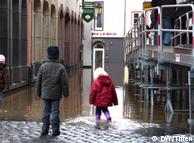
During the middle of January, we where experiencing flooding along the Rhine and Moselle. Neuendorf and Wallersheim (where we live) was particularly hard hit as they are the villages just below the confluence of these two rivers. The waters reached the 7.5 meter mark, well below the record flood levels of around 9.5 meters. but still enough to cover the first story of most of the homes along the Rhine. Our building is high enough that were relatively unaffected. However, Franny did have to experience a change in her routine walks.

For many affected, this was nothing new. The fire department came in before the flood waters reached the town and build walkways allowing people to access the second floor of their homes. People along the river have learned to live mostly on the second floor anyway. Rooms on the first floor only contain furniture that can easily be moved to the second in case of floods. Cars were moved to parking areas on higher ground. And many people stayed in their homes.


Probably the most disruptive event occurred on the Rhine, a few miles upriver, at the base of the Lorelei cliffs. This is a place where the Rhine river narrows and turns as passes around the cliffs. As long as the Rhine has been used by boats, the swift water and turn on this particular section has been a problem for boat captains. The accidents gave rise to the legend of Lorelei, the naked siren with cooper hair that would sign such a beautiful song that she would boat captains into a accident in the swift waters.
 

On January 18, Lorelei got another. This time it was a tanker, the TMS Waldhof,  carrying 2000 tons of sulfuric acid. The big problem here is that the combination of sulfuric acid and water can be explosive, and a couple of the tanks developed leaks that was allowing water into them. It took awhile to get the necessary equipment into place to stabilize the situation. During this time, boat traffic was not permitted along the river at this point, and detours were set up for auto route along the river.. Many boats have had to dock and wait until it was safe. That occurred on Friday morning around 9:30 am. The Waldhof is still in the water, but the tanks have been drained and it is now safe to continue the rescue.